About Us / Introduction
I. About the Project
(1) Cultivating Taiwan's Climate Change Science Services
In 2009, the National Science and Technology Council (NSTC) launched the "Taiwan Climate Change Projection and Information Platform" (TCCIP Project), with the primary mission of producing climate data to fulfill the needs of climate change research in Taiwan and providing value-added data and services. During Phase I (November 2009 – February 2013), the project integrated historical observation data across public and private sectors, established a stable, long-term climate database, and transformed scientific data into usable information. With the accumulated experience in data generation, and value-added services, Phase II (March 2013 – February 2017) expanded research topics to include climate change impacts and adaptation and translated relevant knowledge to facilitate dialogues among researchers across diverse disciplines. The core priorities of this phase aligned with the progressive development of climate science, data, and knowledge services.
In Phase III, the project was officially renamed the "Taiwan Climate Change Projection Information and Adaptation Knowledge Platform" (retaining the acronym TCCIP). During this phase (March 2017 – May 2022), TCCIP strengthened research on climate change adaptation knowledge and adaptation implementation while reinforcing stakeholder engagement, underscoring the vital link between scientific research and practical applications. During Phase IV (June 2022 – May 2026), TCCIP continued to advance climate science modeling and enhance its capacity for climate change adaptation knowledge services, delivering integrated climate services required for academic research, governmental adaptation policy-making, and industrial applications.
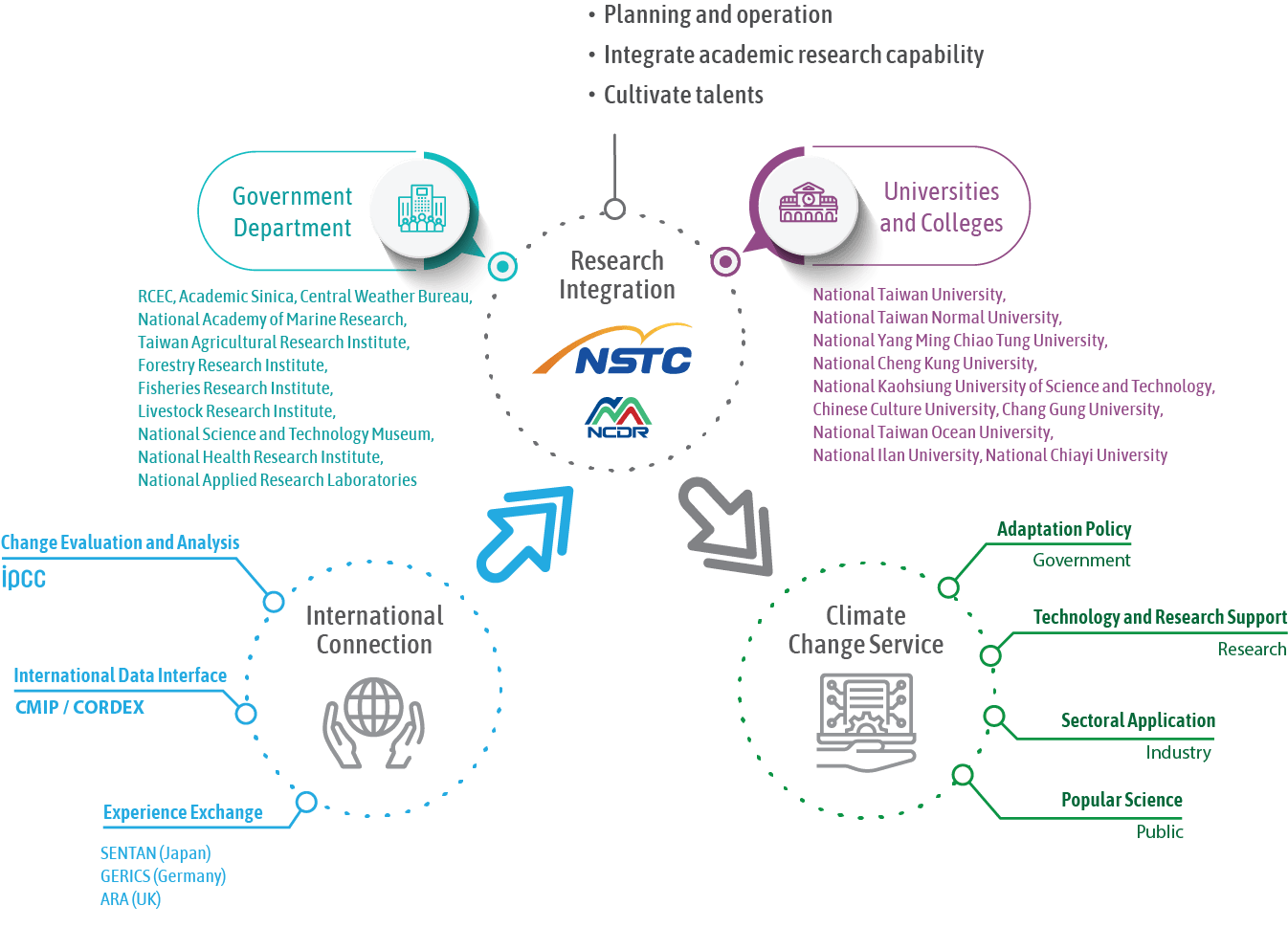
In June 2026, the TCCIP Project entered Phase V (up till May 2031), with the overarching goal of supporting evidence-based adaptation. Aligning with the IPCC Sixth and Seventh Assessment cycles, TCCIP Phase V will remain devoted to providing climate data and value-added information, bolster stakeholder communication, supply risk assessment methodologies and adaptation tools tailored to practical needs, and develop complex risk assessment frameworks. Under the operational structure of the " Climate Change Adaptation Research Ecosystem " TCCIP will assist the NSTC in planning and publishing the National Science Report 2030 to foster science-to-policy interfaces.
(2) Milestones of the TCCIP Project
The TCCIP Project completed the Taiwan Climate Change Scientific Report 2011 and Taiwan Climate Change Scientific Report 2017, featuring dedicated chapters elucidating climate change and future projections at global, East Asia / Western North Pacific, and Taiwan-regional scales, alongside climate hazard and impact data for Taiwan. These reports enhanced public understanding of Taiwan’s historical climate changes and future trends while serving as the scientific basis for public sector adaptation policies. In 2024, the TCCIP Project assisted the NSTC in completing Taiwan’s first national-level climate science report: Climate Change in Taiwan: National Scientific Report 2024, compling essential scientific information to facilitate adaptation capacity building and adaptaion planning across all levels of government.
Since its inception in 2009, the TCCIP Project has maintained robust collaborative relationships with the Ministry of Education, Culture, Sports, Science and Technology in Japan and its cross-disciplinary climate change projects in areas such as climate data generation, climate analysis, and impact assessments. Starting in 2019, TCCIP successively established cooperative channels with the Center for Climate Change Adaptation (CCCA) in Japan and the Climate Service Center Germany (GERICS) in adaptation analysis and climate data services. In addition to earning international recognition and maintaining valuable academic partnerships, TCCIP’s science services have garnered broad domestic acclaim across both public and private sectors: receiving the Executive Yuan's "National Sustainable Development Award" in 2016 and 2025, as well as the "Taiwan Sustainable Action Award (TSAA)" in 2021.
In August 2021, the mission-oriented task force dedicated to climate change research at the National Science and Technology Center for Disaster Reduction (NCDR) was officially institutionalized as the Climate Change Division under NSTC’s support. The Climate Change Division continues to drive the TCCIP Project forward, executing NSTC climate scientific research programs in close partnership with interdisciplinary researchers and relevant government agencies. It develops key technologies and integrated tools for extreme climate hazard risk assessment, reinforces adaptation capacity building, establishes evaluation instruments, and delivers policy assessments and recommendations to underpin national adaptation initiatives.
II. Creating the Climate Change Adaptation Research Ecosystem
The Climate Change Response Act was promulgated and enacted on February 15, 2023. The Act's dedicated adaptation chapter highlights the pivotal importance of climate change science. Specifically, Article 18 mandates that the central competent authority (Ministry of Environment, MOENV) and the central science and technology competent authority (National Science and Technology Council, NSTC) shall periodically publish national climate change science reports and guide governments at all levels in utilizing the scientific evidence to conduct climate change risk assessments as the foundation for formulating and promoting adaptation strategies and actions.
In response to statutory responsibilities designated by the Climate Change Response Act and the pragmatic need to expand national climate research capacities, the NSTC and the MOENV jointly convened relevant ministries and agencies in 2023 to complete the blueprint for the "National Climate Change Adaptation Research Ecosystem". Within this structural framework, the NSTC plays a pivotal role in science translation: delivering high-resolution climate datasets and forward-looking adaptation research findings, linking policy implementation through climate adaptation research, and reinforcing the scientific, evidence-based foundation for sectoral adaptation governance. Leveraging its service platform and inter-ministerial research communication mechanisms, the TCCIP Project assists the NSTC in delivering comprehensive climate services to diverse ministries across the ecosystem.
III. Overarching Goals of the TCCIP Project
The TCCIP Project will continue to develop and iteratively refine climate change risk assessment and adaptation methodologies, serving as the benchmark for national climate scenario setting and the review/revision of adaptation frameworks, while facilitating the planning and publication of national climate change scientific report. Through targeted science translation and web-based visualization, TCCIP aims to disseminate its adaptation science services broadly. Concurrently, in coordination with the promotion of the "National Climate Change Adaptation Research Ecosystem," TCCIP assists the NSTC in delivering tailored science translation services to support academic research, governmental adaptation administration, public science literacy, and industry applications.
Key highlights of the overall goals for this phase are summarized as follows:
- Supporting NSTC Missions: In addition to aligning with NSTC objectives for adaptation scientific research under the National 2030 Sustainable Development Goals, TCCIP phase V will consistently support the National Climate Change Adaptation Action Plan and fulfill climate adaptation application mandates assigned to the central science and technology authority.
- Taiwan Climate Change Data Production and Trend Analysis: While previous phases focused on generating large-scale climate datasets for domestic impact studies, this phase will advance high-resolution climate simulations, update regional ocean and coastal modeling and analytics, and deepen the analysis and application of the Taiwan ReAnalysis Data (TReAD) and Taiwan Ocean Reanalysis Data (TOReD). In tandem with global climate dataset releases and the upcoming IPCC AR7, the project will refine scientific analyses to provide localized, readily interpretable climate information for domestic stakeholders.
- Building up capacity for Climate Risk Assessment and Adaptation: Through inter-ministerial collaboration on national climate adaptation, the project's knowledge outputs will continue to support governmental agencies in practical adaptation operations and serve as a scientific guide for local governments developing adaptation programs. The project will continuously enrich its repository of experiences, tools, spatial datasets, and knowledge in cross-sectoral impact and risk assessments as well as adaptation framework implementation.
- Enhancing Climate Change Adaptation Scientific Service : As Taiwan’s flagship platform for climate change adaptation science services, TCCIP has established a substantial user base spanning industry, government, and academia. TCCIP phase V will incorporate emerging artificial intelligence (AI) technologies to optimize service capabilities, lower barriers to specialized domain knowledge, and bridge cross-disciplinary application gaps.
- Fostering Research Talent and Capabilities: By maintaining steady momentum in national climate science initiatives, TCCIP will nurture interdisciplinary talent and operational capacity across applied research, service delivery, and communication—pursuing sustainable operations to proactively tackle the increasingly formidable challenges of climate change.
IV. Organization
TCCIP also supports the climate adaptation-related tasks for the National Science and Technology Council (NSTC) by assisting to bridge 'Research' with 'Operation.'
TCCIP is therefore divided into three teams (Team 1, 2, and 3), of which all can function independently but constantly work under a collaborative spirit.
-
Team1 generates various climate information and conducts climate change analysis. This includes the improvement of climate analytical techniques for producing high-resolution observation and projection data sets. Value-added studies such as analyzing climatic patterns are also one of the team’s critical tasks to meet sectoral needs.
-
Team2 investigates climate change impact and adaptation application. This includes the evaluation of climate change hazards, impacts and adaptation strategies in ten thematic areas (agriculture, water resources, landslide, inundation, coastal zones, fisheries, forestry, cattle farming, health, and urban heat island). Developing an adaptation framework, knowledge system and tailored tools and maps is also the key part of the research scope of Team2.
-
Team3 acts as the main information outlet for the TCCIP project by providing updated information and promoting climate change services. TCCIP’s integrated platform and functions (e.g., climate change data store and adaptation resources kit) are maintained and operated by this team. Regular additions of tools and knowledge to the platform are made based on the feedback provided by users. On top of that, one of the main missions of this team is to enhance cross-disciplinary collaboration and communication by improving knowledge transfer and the active promotion of climate change research results.
Updated: Sep 23, 2026