Adaptation Framework : Promote implementation
Adaptation Option : Ecological,Structural
Issue : Insufficient irrigation water
Core Content : Adjust irrigation methods
Case Characteristics : practical operation
Scale : Transnational/National
Author : Liu Yuzhen
View : 3845
- Due to insufficient water sources, imperfect irrigation systems, and competition from other water uses (such as industrial and domestic water), Taiwan is experiencing increasingly frequent water shortages.
- Furthermore, a drought occurred in Taiwan from late 2014 to 2015, resulting in an actual suspension of irrigation for 31,000 hectares of farmland across the island.
- Traditional paddy field cultivation generally maintains a continuous irrigation method with 5 cm of standing water throughout the growing period. Under the impact of climate change on water resource supply, effective management of water resources has become a critical issue for Taiwan.
Improvement Measures Taken
The Council of Agriculture's Water Resources Agency began promoting the "Feasibility Assessment of Strengthening the System for Rice Intensification (SRI) Cultivation and Its Impact on Water Resources Project" in 2009 to enhance water use efficiency in rice cultivation and advocate for environmentally friendly farming methods for farmers.
A key factor in SRI is water control, which involves cultivating rice paddies with minimal water, combined with early planting and wide spacing. It emphasizes the "Three More, Four Less" environmentally friendly farming method: more sun exposure for the field, more weeding/intercultivation, more organic matter, less seedling density, less pesticide use, less water, and less chemical fertilizer. Based on data and analysis collected from domestic and international sources, elements such as water management suitable for Taiwan's climate change environment, a rice cultivation system prioritizing both quality and quantity, and rationalized irrigation operating costs were summarized. Subsequently, based on meteorological zoning, SRI principle cultivation management was implemented separately in the northern, central, and southern regions. The observation test sites are as follows:
- Mianli, Miaoli: Organic SRI principles were implemented for five consecutive cropping seasons, starting from the second crop season of 2010, on approximately 1 hectare of organic rice-duck fields.
- Houbi, Tainan: Basic SRI principles were implemented for four consecutive cropping seasons on an approximately 0.8-hectare conventional farming trial field within the Baihe Reservoir irrigation area during the 2011 season.
- Citong, Yunlin: SRI principles were implemented on approximately 0.6 hectares of conventional paddy fields within the Jiji Weir irrigation area of the Zhuoshui River for two cropping seasons in 2012.
- Guandu, Taipei: Following the drought in 2014-2015, retired National Taiwan University Professor Gan Jun-Er and the Qixing Water Conservancy Research and Development Foundation tested water-saving technology for SRI rice cultivation on the Guandu Plain.
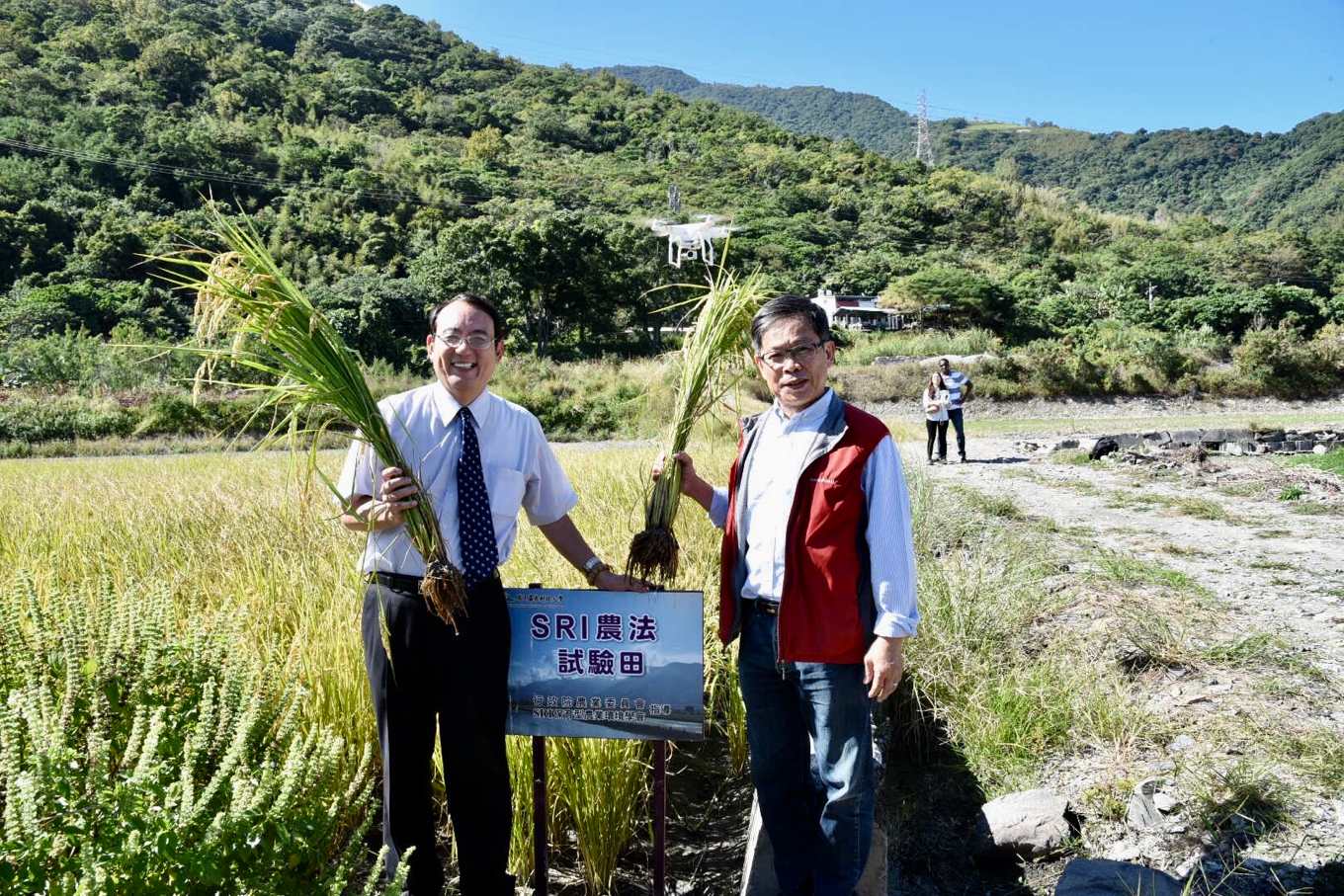
- Guanshan, Taitung: The water-saving laboratory led by Professor Wang Yu-Min, Chair of the Department of Civil Engineering at National Pingtung University of Science and Technology, also conducted SRI rice cultivation trials on a piece of barren farmland in Guanshan, Taitung (Figure below).
Results
- Through intermittent irrigation—watering with 3 cm of water after drying the field for 2–3 days—the field is exposed to sunlight, even allowing the ground to crack. This helps the rice plants gradually adapt to dry, hard ground, forcing an increase in root length, which strengthens the rice root system, allowing it to withstand the challenge of wind disasters.
- Field drying relatively reduces irrigation water usage, saving about 25% of the water compared to traditional irrigation. SRI provides greater flexibility in water resource management for Taiwan’s first rice crop, which often faces water shortages.
- Field drying increases soil aeration, which aids root absorption. Consequently, the frequency of fertilization can be reduced in SRI fields.
- Adjusting the 8–10 rice seedlings used in conventional farming to a 3–5 seedling transplanting method not only reduces the number of seedlings and transplanting costs but also allows individual plants to receive more nutrients within the same planted area, thereby boosting tillering capacity and increasing yield. Taking the experimental site in Guanshan, Taitung, as an example, Professor Yu-Ming Wang of the Department of Civil Engineering at National Pingtung University of Science and Technology stated: "In terms of average yield, the harvest from traditional planting methods is 10,000 *jin* (units of weight), while the harvest using the SRI method can reach 13,000 *jin*. The reason for this is the increased tillering capacity, so although fewer plants are grown, the yield is higher than with the traditional method."
TERMINOLOGY
Climate Change Risk Assessment: Utilizes effective assessment tools to understand the medium-to-long-term impacts of climate change across various fields, and proposes corresponding adaptation strategies and actions to mitigate the risks associated with climate change.
Case Types:
Structural and Physical Options: Engineering techniques or the reinforcement of existing structures, integrated technology research and development.
Social Options: Learning and exchange of disaster knowledge within communities, research and development and application of early warning information.
Institutional Options: Establishment of systems at the economic, policy, and legal levels.
References
Reference Websites
- 農田水利處。強化水稻用水栽培體系可行性評估及其對水資源之影響計畫執行成果---苗栗苑裡、雲林莿桐、台南後壁https://www.coa.gov.tw/ws.php?id=2447692。
- 台灣強化稻作栽培體系。http://taiwansri.blogspot.com/。
- 上下游。減水3成「根」強壯 關渡SRI種稻試驗 為氣候變遷找出路。https://www.newsmarket.com.tw/blog/73152/。
- 上下游。顛覆傳統種稻!王裕民團隊研究十年,水稻「三多四少」可節水3成,產量卻上升。https://www.newsmarket.com.tw/blog/103483/。