Taiwan - Tainan City’s 2015 dengue fever prevention mentor program
Adaptation Framework : Promote implementation
Adaptation Option : Behavioral
Issue : Dengue fever outbreak
Core Content : Training seed instructors for breeding site elimination
Case Characteristics : practical operation
Scale : City/County
Author : Fu Zongqiang
View : 2043
Issues and Objectives
In 2015, a large-scale dengue fever outbreak occurred in Tainan. The outbreak began to escalate on May 21st, when the first local case was confirmed. By July 17th, Tainan City had accumulated 57 confirmed cases. The Tainan City Dengue Fever Epidemic Command Center was established, followed by district-level command centers and forward command posts in various neighborhoods to carry out prevention and control work. Although each case underwent 50-meter mosquito breeding site elimination and chemical control according to dengue fever prevention guidelines, and the National Army Chemical Corps was deployed on August 11th to assist with chemical control, the spread of the epidemic was not successfully prevented. On September 15th, the Executive Yuan established the Central Dengue Fever Epidemic Command Center, which went to Tainan for frontline supervision. Considering the thoroughness of mosquito breeding site elimination and the correctness of chemical control methods, the Centers for Disease Control and Prevention's mosquito breeding site elimination advisory team began various mosquito breeding site elimination training and chemical control inspections on September 20th, training mosquito breeding site elimination personnel and initiating various prevention and control plans.
Improvement Measures Taken
The Central Epidemic Command Center has planned a mosquito breeding source elimination mentor program, establishing a mosquito breeding source elimination advisory group to serve as seed teachers in Tainan City for mosquito breeding source elimination work. The group will guide and train local government personnel to carry out mosquito breeding source elimination in households and the environment, enhance the effectiveness of elimination, and select qualified and outstanding mosquito breeding personnel for training to become key personnel for future dengue fever prevention and control work, so that the prevention and control capabilities can take root and be passed on locally.
Content and methods of the breeding grounds elimination mentor program:
- The Vector Control Advisory Group consists of 40 personnel from the Centers for Disease Control who have obtained professional and technical personnel qualification certificates in vector control, and 3 retired personnel with experience in vector control.
- Personnel scheduling and processing time: One person will serve as the head of the mosquito eradication advisory team, responsible for personnel scheduling, task assignment, and coordination. The project will be implemented from September 19th to October 9th, 2015, with each phase lasting one week.
- Execution content
- Each group of the breeding pest control advisory team consists of two people who go to different areas with more severe outbreaks to meet with the training participants from each area. They first explain the basic knowledge and then conduct on-site inspections and demonstrations.
- The next step is to conduct on-site assessments of the mosquito breeding site elimination efforts of the participants in each district. Those who pass the mosquito breeding site elimination assessment will be selected, and then a second assessment will be conducted among them to select those who excel in mosquito breeding site elimination.
Results
The Breeding Site Elimination Mentor Program was implemented from September 19, 2015, with each session lasting one week. The program ran for a total of three weeks, ending on October 9, 2015. The Breeding Site Elimination Advisory Team mobilized 296 personnel to train and inspect 151 villages in the seven high-risk areas of Tainan City (East, South, Central-West, North, Annan, Anping, and Yongkang districts) for breeding site elimination and pesticide spraying. To evaluate the program's effectiveness, 564 people participated in the training, with 529 passing the initial training (see Table 1 below), resulting in a pass rate of 93.8%. Among those who passed the initial training, 51 individuals received refresher training and were recognized as outstanding breeding site elimination trainees (5 from the East district, 20 from the Central-West district, 7 from the North district, 7 from Anping district, and 12 from Yongkang district).
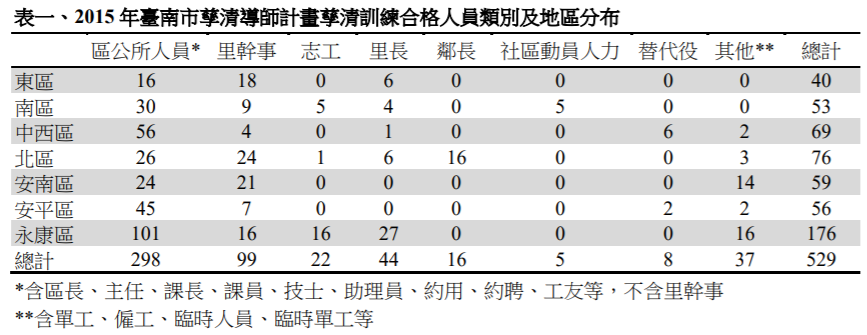
Source: Reference 2
In addition to training and assessing personnel in various districts, the Breeding Control Advisory Team also conducted on-site inspections and demonstrations in various neighborhoods. The neighborhoods they inspected were mainly those that had been repeatedly inspected by breeding control personnel before the implementation of the Breeding Control Mentor Program, as well as areas where outbreaks had occurred. The average number of positive containers per neighborhood inspected was 3.1 (see Table 2 below).
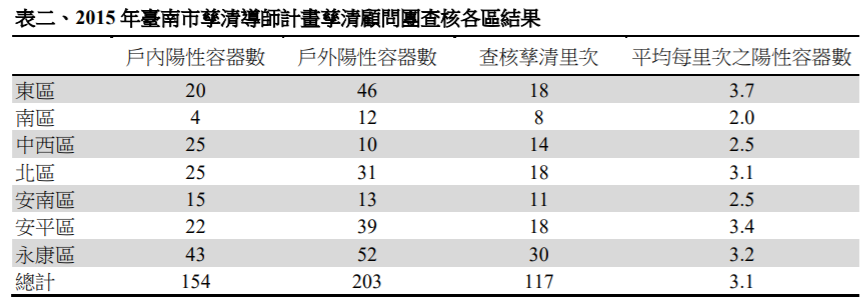
Source: Reference 2
Due to climate change, the future climate will be more favorable for the survival of disease-carrying mosquitoes, which may lead to an expansion of dengue fever outbreaks in densely populated areas of central and northern Taiwan. If the mosquito breeding mentor program is implemented first in central and northern Taiwan, it can be regarded as an adaptation strategy to strengthen the public health and epidemic prevention system in response to future climate change.
References
- Tainan City Government. Dengue Fever Prevention Measures in Tainan City, 2015 (pp. 55-56).https://www.epa.gov.tw/DisplayFile.aspx?FileID=A855559D43922D95&P=f8c91f72-8ff1-4d10-8e8b-883b9597508c。
- Chi, Chin-sheng; Liu, Pi-lung; Wang, Jen-te; & Hsieh, Jui-wei (2017). Enhancing and Strengthening Dengue Fever Prevention Skills in Local Governments: A Case Study of Breeding Instructors and Larval Extermination Programs. Epidemic Reports, Vol. 33, No. 14, pp. 255-262.
Reference Websites