Taiwan - Tainan City’s 2015 dengue fever prevention breeding source elimination efforts
Adaptation Framework : Promote implementation
Adaptation Option : Structural
Issue : Dengue fever outbreak
Core Content : Elimination of mosquito breeding sites
Case Characteristics : practical operation
Scale : City/County
Author : Fu Zongqiang
View : 2090
Issues and Objectives
In 2015, a large-scale dengue fever outbreak occurred in Tainan. The outbreak began to escalate on May 21st, when the first local case was confirmed. By July 17th, Tainan City had accumulated 57 confirmed cases. The Tainan City Dengue Fever Epidemic Command Center was established, followed by district-level command centers and forward command posts in various neighborhoods to carry out prevention and control work. Although each case underwent 50-meter mosquito breeding site elimination and chemical control according to dengue fever prevention guidelines, and the National Army Chemical Corps was deployed on August 11th to assist with chemical control, the spread of the epidemic was not successfully prevented. On September 15th, the Executive Yuan established the Central Dengue Fever Epidemic Command Center, which went to Tainan for frontline supervision. Considering the thoroughness of mosquito breeding site elimination and the correctness of chemical control methods, the Centers for Disease Control and Prevention's mosquito breeding site elimination advisory team began various mosquito breeding site elimination training and chemical control inspections on September 20th, training mosquito breeding site elimination personnel and initiating various prevention and control plans.
Improvement Measures Taken
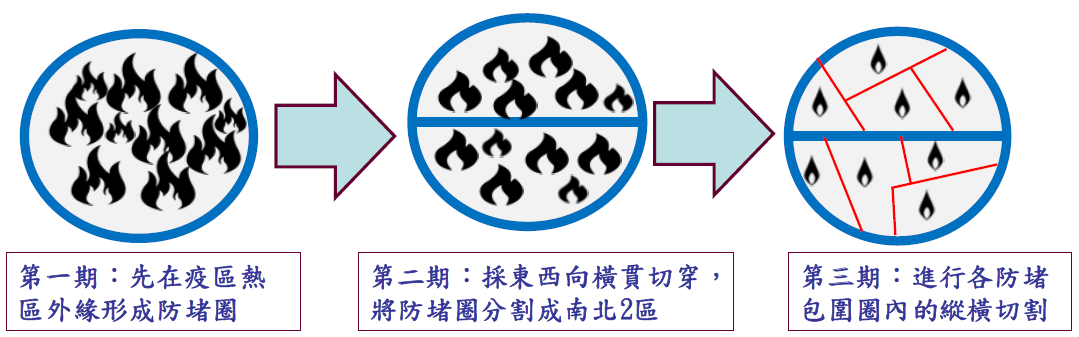
Figure 1. Epidemic prevention and control process (Image source: References 2-7)
The Phormios Strategy was developed: Disease control personnel formed a firewall by encircling the area from the outside, then cut into smaller sections inside to fragment mosquito habitats for breeding control and chemical spraying. The Southern Regional Control Center of the Centers for Disease Control (CDC) proposed lists of firewalls and hotspot areas based on the phased spread of the epidemic, delineating zones as shown in the diagram below.
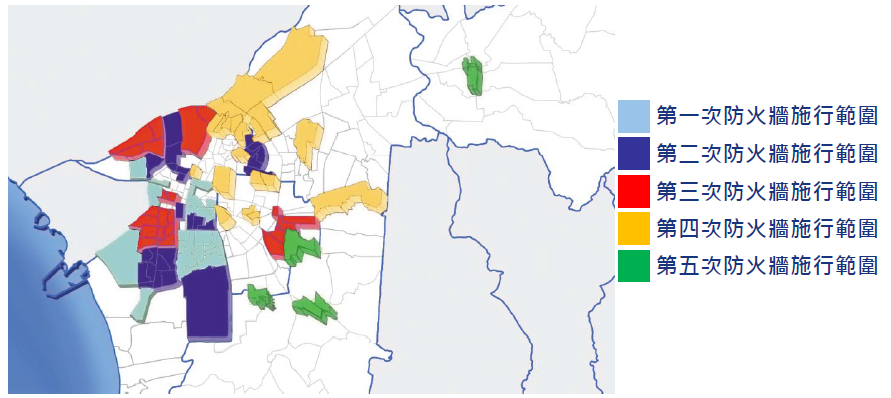
Figure 2. Firewall Scope (Image source: Reference 1 - Page 59)
The Environmental Protection Administration and Tainan City Government then formulated and implemented a plan to enforce the removal of breeding grounds. The cleanup was carried out in five phases from September 23 to October 28, covering a total of 96 neighborhoods, as shown in the table below.
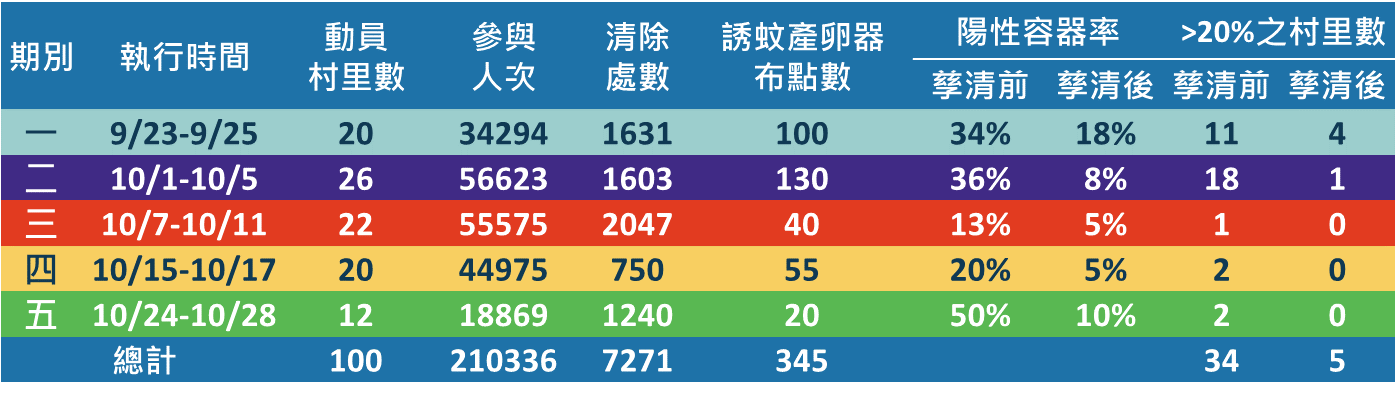
Source: Reference 2
During this period, inspections and cleanups were carried out on schools, markets, temples, and side ditches or ditches behind houses.
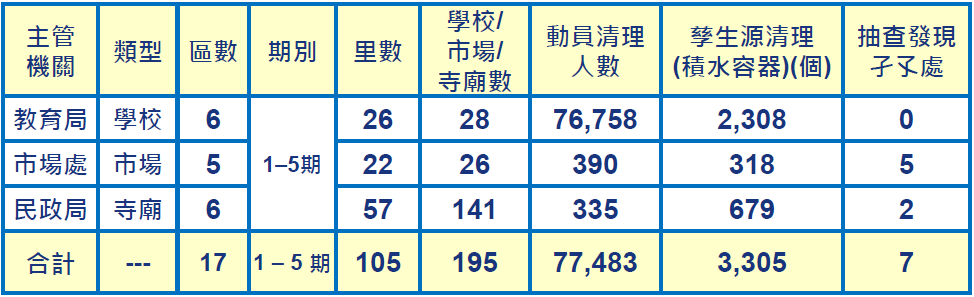
Figure 3. Inspection and cleanup locations (References 1-62)
During the fifth phase, 98, 32, 52, 128, 7, 4, and 10 locations (a total of 331 locations) of side ditches or back ditches were inspected and cleaned in the central and western districts, the northern district, the southern district, the eastern district, the Yongkang district, the Rende district, and the Xinhua district, respectively.
Results
The effective cleanup of stagnant water containers and unsanitary areas in key areas of Tainan City reduced suitable habitats for disease-carrying mosquitoes, and the results are shown in the table below.
This adaptation case establishes an effective prevention and control strategy for large-scale outbreaks. Due to climate change, the future climate will be more favorable for the survival of disease-carrying mosquitoes, which may lead to the normalization of large-scale dengue fever outbreaks in the south. Therefore, normalizing this prevention and control strategy can be regarded as an adaptation strategy to strengthen the public health and epidemic prevention system in response to future climate change.
Glossary
Climate change risk assessment: Using effective assessment tools to understand the medium- and long-term impacts of climate change on various sectors, and to propose corresponding adaptation strategies and actions to reduce the risks brought about by climate change.
Case type:
Structural and physical options: engineering techniques or reinforcement of existing structures, integrated technology development
Social options: learning and exchanging disaster knowledge in the community, and developing and applying early warning information.
Institutional options: Establishing institutions at the economic, policy, and legal levels
References
- Tainan City Government. Dengue Fever Prevention Measures in Tainan City, 2015 (pp. 59-62).https://www.epa.gov.tw/DisplayFile.aspx?FileID=A855559D43922D95&P=f8c91f72-8ff1-4d10-8e8b-883b9597508c。
- Environmental Protection Administration (2016). Status and future prospects of dengue fever prevention and control.https://www.epa.gov.tw/DisplayFile.aspx?FileID=DBF57DB2DF6E7360&P=9e44bee4-7340-4e7b-80b3-be1317f742c8。
Reference Websites