Taiwan - Tainan City’s 2015 dengue fever eradication program
Adaptation Framework : Promote implementation
Adaptation Option : Structural
Issue : Dengue fever outbreak
Core Content : Elimination of mosquito breeding sites
Case Characteristics : practical operation
Scale : City/County
Author : Fu Zongqiang
View : 1942
Issues and Objectives
In 2015, a large-scale dengue fever outbreak occurred in Tainan. The outbreak began to escalate on May 21st, when the first local case was confirmed. By July 17th, Tainan City had accumulated 57 confirmed cases. The Tainan City Dengue Fever Epidemic Command Center was established, followed by district-level command centers and forward command posts in various neighborhoods to carry out prevention and control work. Although each case underwent 50-meter mosquito breeding site elimination and chemical control according to dengue fever prevention guidelines, and the National Army Chemical Corps was deployed on August 11th to assist with chemical control, the spread of the epidemic was not successfully prevented. On September 15th, the Executive Yuan established the Central Dengue Fever Epidemic Command Center and went to Tainan for frontline supervision. Considering the thoroughness of mosquito breeding site elimination and the correctness of chemical control methods, the Centers for Disease Control and Prevention's mosquito breeding site elimination advisory team began various mosquito breeding site elimination training and chemical control inspections on September 20th. Following the implementation of the mosquito breeding mentor program and the enhanced mosquito breeding source elimination project, initial results have been achieved. From October 31st to November 16th, to further strengthen the elimination and promotion of mosquito breeding sites and high-risk areas both indoors and outdoors, the mosquito eradication plan was implemented, and the disease prevention goals were indeed achieved. To preserve the results of disease prevention and integrate human and material resources, through repeated inspections of high-risk outdoor breeding sites in the burned areas, mosquitoes were eradicated to prevent the spread of the disease into winter. Therefore, the "Mosquito Eradication Plan" was implemented starting November 16th.
Improvement Measures Taken
The execution details and methods of the "Exterminate All Children" plan:
- Plan implementation period and scope
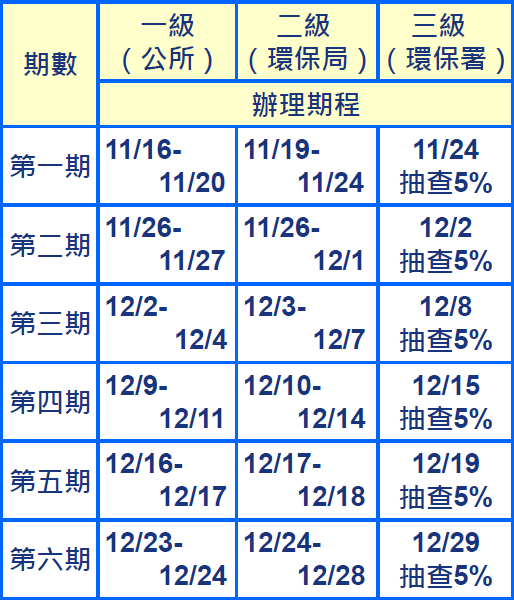
The processing time is shown in the table below. The scope of implementation is for cases that develop symptoms 14 days after prevention and control, and whose onset date is between week 43 and 44 of 2015 (October 25 - November 7). According to the statistics of the Centers for Disease Control, there are a total of 272 locations in 7 districts. After analysis and comparison by this Bureau to exclude duplicate or adjacent locations, there are 234 locations.
- Mobilize manpower
Eighty experienced dengue fever inspectors were mobilized and divided into 20 groups to complete the re-inspection work in 5 days.
- Execution content
- Inspection: For the 410 backfire areas mentioned in this plan, inspect the high-risk outdoor areas and breeding grounds within a range of at least 50 meters and carry out breeding ground removal work.
- Records: Any positive water ditches or breeding grounds found during the patrol (such as ditches behind houses, fire lanes, large positive containers, rainwater gutters, etc.) must be recorded in a record form and photographed.
- Management and handling: If breeding grounds are found that cannot be removed on-site, or if there are blockages or positive water sources, take photos and report to the Environmental Protection Bureau's district team for removal or relevant departments for handling, and follow up until the breeding grounds are removed and improved.
- Results Summary
Once this plan is completed, the results of the outdoor breeding site inspection will be provided to each township office for management and regular inspection.
Results
References
Tainan City Government. 2015 Dengue Fever Prevention Measures in Tainan City.(p.71-78)。https://www.epa.gov.tw/DisplayFile.aspx?FileID=A855559D43922D95&P=f8c91f72-8ff1-4d10-8e8b-883b9597508c
Reference Websites