Taiwan - Effectiveness of dengue fever prevention and control in Pingtung County in 2013
Adaptation Framework : Promote implementation
Adaptation Option : Structural
Issue : Dengue fever outbreak
Core Content : Elimination of mosquito breeding sites
Case Characteristics : practical operation
Scale : City/County
Author : Zhang Yijia
View : 1706
Issues and Objectives
Dengue fever is one of the most important vector-borne infectious diseases in the world, with outbreaks occurring mostly in countries near tropical and subtropical regions. Studies indicate that, based on the 2010 global population, approximately 390 million people worldwide are infected with dengue fever each year, of which 300 million are asymptomatic or asymptomatic, posing a significant challenge to disease prevention and control.
The global risk of dengue fever outbreaks is increasing year by year, posing a growing challenge to public health in Taiwan, while dengue fever prevention funding is decreasing annually. Since there is currently no effective treatment for dengue fever and a vaccine is still under development, the most effective measure for dengue fever prevention is controlling the breeding of mosquitoes. Until more resources are allocated, the effectiveness of related prevention measures needs to be continuously evaluated.
Improvement Measures Taken
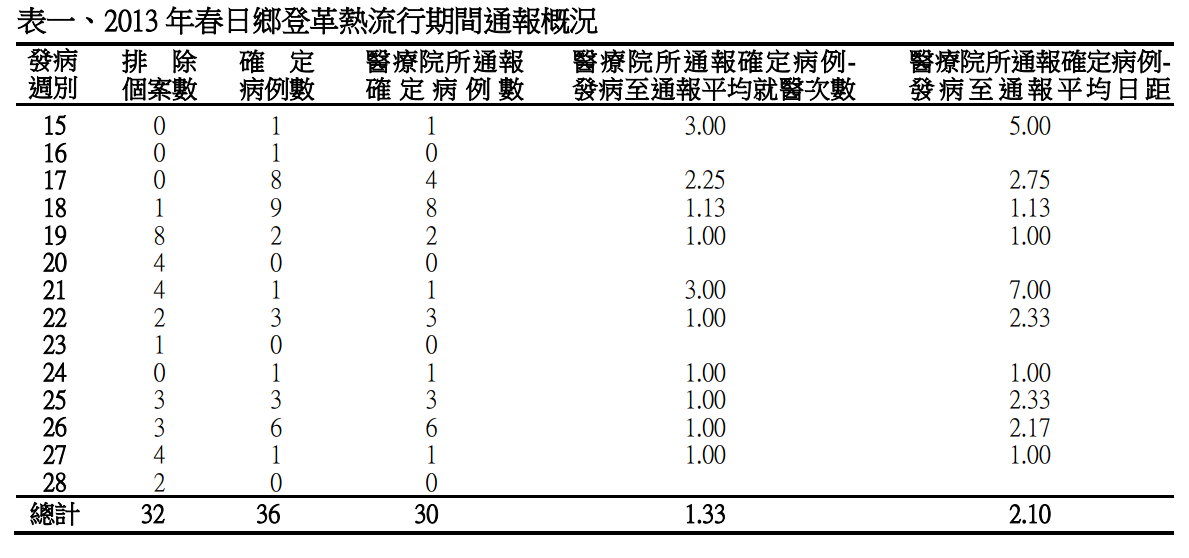
The outbreak originated in Chunri Township, located in the southeastern corner of Pingtung County. On April 15, 2013, a regional hospital in Pingtung County reported the first suspected case of locally acquired dengue fever in a 59-year-old woman residing in Qijia Village, Chunri Township. On April 23, a second blood test by the Centers for Disease Control (CDC) confirmed the case as dengue fever. Further investigation expanded the investigation, and the outbreak in Chunri Township continued until July 2 (week 27). Monitoring continued until August 24, with a total of 68 reported cases, of which 36 were confirmed.
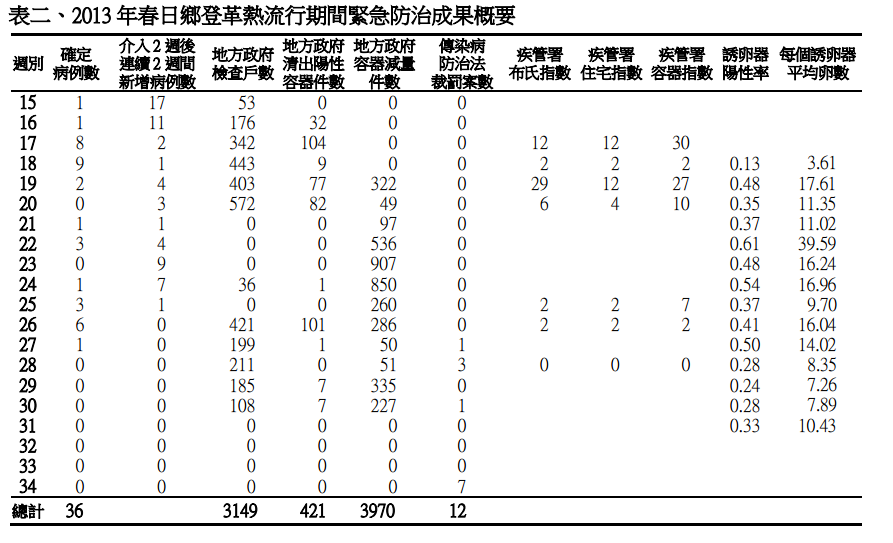
In terms of actual prevention and control work, from week 15 to week 34, a total of 3,149 households were investigated, 421 breeding grounds were eliminated, and 3,970 containers were reduced in number. Related public awareness campaigns were also strengthened. Inspections and reports were continuously implemented starting May 31 (week 22), and on July 3 (week 27), the first administrative penalty notice was issued in accordance with the Infectious Disease Prevention and Control Act. A total of 12 administrative penalty notices were issued during the outbreak. A summary of the implementation of relevant prevention and control measures is shown in Table 2 below.
Results
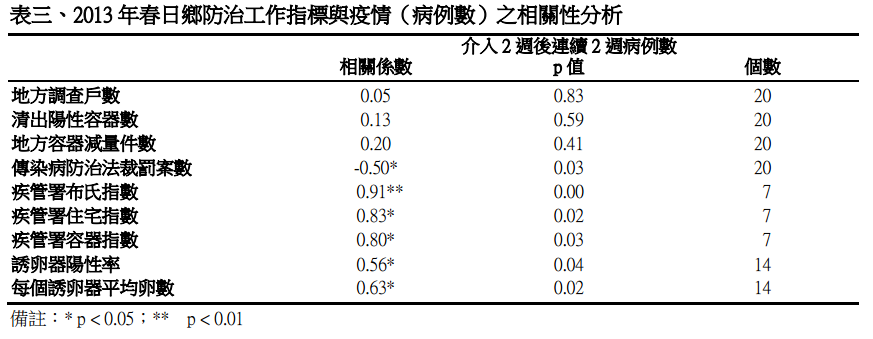
Spearman's correlation analysis was performed on various prevention and control achievement indicators and the number of new cases in the two consecutive weeks after intervention. The results are shown in Table 3 below. The number of cases was moderately significantly negatively correlated with the number of penalties (gamma;s = -0.50), and significantly positively correlated with the mosquito vector index and oviposition monitoring in the CDC's post-control effectiveness assessment (gamma;s = 0.56–0.91).
Due to climate change, the future climate will be more favorable for the survival of disease-carrying mosquitoes, which may lead to the normalization of large-scale dengue fever outbreaks in the south. Therefore, normalizing this prevention and control strategy can be regarded as an adaptation strategy to strengthen the public health and epidemic prevention system in response to future climate change.
Glossary
Climate change risk assessment: Using effective assessment tools to understand the medium- and long-term impacts of climate change on various sectors, and to propose corresponding adaptation strategies and actions to reduce the risks brought about by climate change.
Case type:
Structural and physical options: engineering techniques or reinforcement of existing structures, integrated technology development
Social options: learning and exchanging disaster knowledge in the community, and developing and applying early warning information.
Institutional options: Establishing institutions at the economic, policy, and legal levels
References
Chien Hsin-fan, Tuan Yen-chang, Hung Min-nan, et al. A preliminary study on the effectiveness of dengue fever prevention and control in Chunri Township, Pingtung County in 2013. Epidemic Report 2015:31(15):387-93.
Reference Websites