Taiwan - Effectiveness of dengue fever prevention and control in Taichung City in 2015
Adaptation Framework : Promote implementation
Adaptation Option : Behavioral
Issue : Dengue fever outbreak control
Core Content : Epidemic prevention plans and personnel training
Case Characteristics : practical operation
Scale : City/County
Author : Zhang Yijia
View : 2151
Issues and Objectives
In 2015, Taiwan experienced its most severe dengue fever outbreak in nearly a decade, with a total of 43,784 confirmed cases nationwide. Of these, 43,419 were locally transmitted (99.2%) and 365 were imported (0.8%), highlighting the severity of the local dengue fever epidemic in Taiwan. The outbreak began at the Ximending flea market in Tainan's North District. Taichung City reported its first locally transmitted dengue fever case in mid-July of that year, and the case had a history of activity at the Ximending flea market during the incubation period, suggesting that Taichung's dengue fever outbreak was influenced by southern Taiwan. Due to convenient transportation and frequent population movement, the central Taiwan area's one-day living circle may have facilitated the spread of dengue fever. To control the spread of the epidemic, quickly identifying the activity locations of dengue fever cases was imperative.
Improvement Measures Taken
Based on the infectious disease statistics query system of the Centers for Disease Control, Ministry of Health and Welfare, the epidemic trend and distribution area of dengue fever in Taichung City were analyzed. The prevention and control results were reported regularly by various departments of the Taichung City Government on a weekly basis, and then the Health Bureau compiled the prevention and control results data of various departments.
Starting September 3, 2015, the Taichung City Government convened a cross-departmental response meeting, chaired by the Deputy Mayor, to address a dengue fever outbreak. On September 14, the Mayor approved the establishment of the Taichung City Dengue Fever Prevention Center at a municipal meeting, and a dengue fever prevention expert consultation meeting was held on September 15. From September 25 to October 30, weekly meetings of the Taichung City Dengue Fever Prevention Center were held every Friday. Each department, according to the organizational structure of the Taichung City Government Dengue Fever Prevention Center (see diagram below), implemented prevention measures such as source control, chemical control, and health education in their respective areas, and reported prevention results weekly. To prevent outbreaks, in 2016, each department continued to implement the 2016 Dengue Fever Prevention Plan.
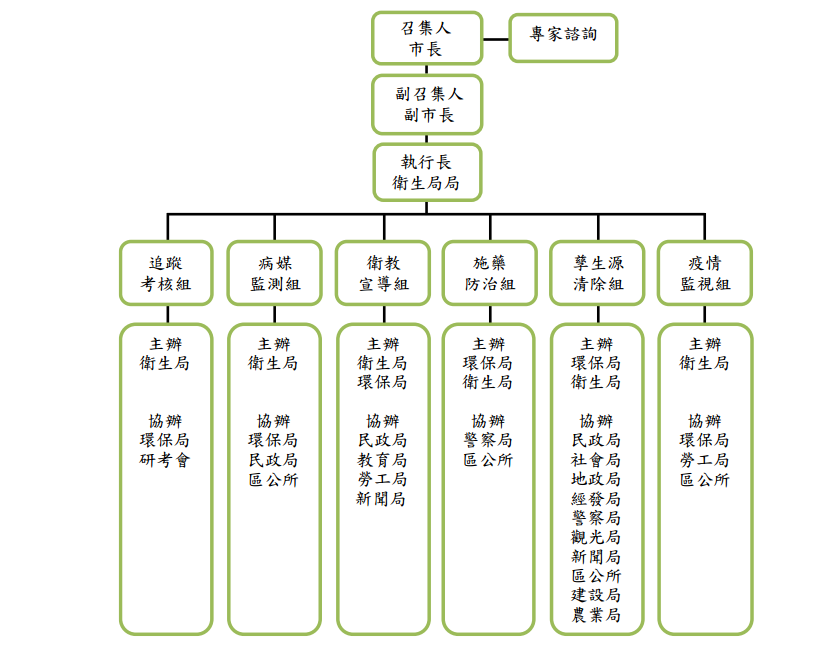
In addition to maintaining regular contact with the three neighboring counties of Changhua, Nantou and Miaoli via telephone, Taichung City also invites the health bureaus of Changhua, Nantou and Miaoli to participate in bi-weekly meetings through the Central Taiwan Dengue Fever Prevention Platform to jointly prevent and control dengue fever.
Results
- Epidemic monitoring and prevention measures: Taichung City's epidemic prevention personnel are on standby 24 hours a day. Upon receiving reports of suspected dengue fever cases from medical institutions, they immediately conduct tracking and monitoring, investigate the density of disease-carrying mosquitoes at the locations where the cases have been, and carry out source elimination.
- Training was conducted for personnel involved in mosquito control and spraying, with a total of 250 people trained. New thermal fogging disinfection vehicles were purchased. Medical preparedness: The Health Bureau reported the latest dengue fever outbreak information, and various departments reported on the control results in their respective managed areas, in order to identify dengue fever hotspots in Taichung City and carry out related control work (see Table 1 below).
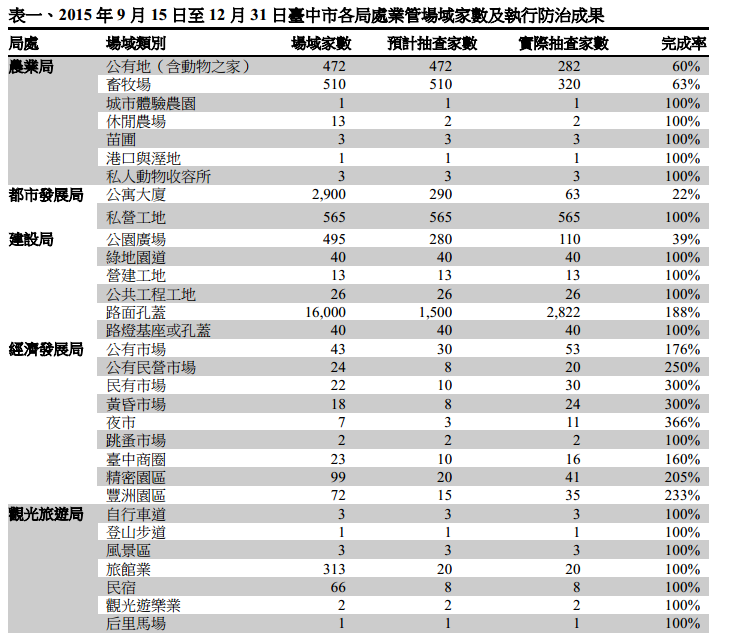
- Mosquito density survey and breeding source elimination: Designated clean-up days are established, and community members and volunteers are mobilized to eliminate breeding sources. At the same time, the Health Bureau conducts an annual mosquito density survey.
- On-site drills: The Taichung City Government selected Fengtian Village in Fengyuan District to conduct on-site drills and recorded the drill process, which was then edited into a dengue fever district-level prevention and control team education and training video.
- Diversified health education and outreach: In addition to basic outreach methods such as radio broadcasts and scrolling text, outreach is also conducted on popular social networking platforms such as Line and Facebook to help younger generations better integrate.
- The Health Bureau conducted a mosquito density survey: In Taichung City, out of 625 neighborhoods, 1,584 mosquito density surveys were completed in 2015. For the 37 neighborhoods with a Brucella index of 2 or higher, the Environmental Protection Bureau, along with the relevant district offices and neighborhood offices, were requested to jointly strengthen mosquito breeding source elimination efforts.
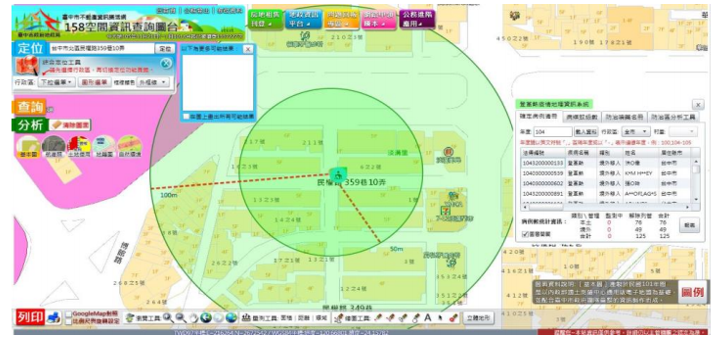
- Data compilation and public disclosure: The Health Bureau, through inter-departmental cooperation and in conjunction with the Land Administration Bureau's information-based lifestyle website, provides dengue fever vector mosquito density survey information for public reference. The image below shows the prevention and control zones for hot and warm areas at 50 and 100 meters.
Due to climate change, the future climate in central Taiwan will be more favorable for mosquito survival, potentially increasing the risk of dengue fever in the region. This case study, demonstrating the cross-departmental integrated model for dengue fever prevention in Taichung City, can be seen as an adaptation strategy to strengthen the public health and disease prevention system in response to future climate change.
Glossary
Climate change risk assessment: Using effective assessment tools to understand the medium- and long-term impacts of climate change on various sectors, and to propose corresponding adaptation strategies and actions to reduce the risks brought about by climate change.
Case type:
Structural and physical options: engineering techniques or reinforcement of existing structures, integrated technology development
Social options: learning and exchanging disaster knowledge in the community, and developing and applying early warning information.
Institutional options: Establishing institutions at the economic, policy, and legal levels
References
The Cross-Departmental Integration Model and Implementation Results of Dengue Fever Prevention in Taichung City in 2015, Lin Shih-wei et al., Epidemic Report, Vol. 33, No. 10, May 23, 2017. DOI: 10.6524/EB.20170523.33(10).001
Reference Websites