Taiwan - Response measures to the first dengue fever cluster outbreak in eastern Taiwan
Adaptation Framework : Promote implementation
Adaptation Option : Behavioral
Issue : Dengue fever outbreak control
Core Content : Elimination of mosquito breeding sites and disease prevention
Case Characteristics : practical operation
Scale : City/County
Author : Zhang Yijia
View : 2069
Issues and Objectives
Dengue fever is an acute infectious disease transmitted by the dengue virus via Aedes aegypti or Aedes albopictus mosquitoes. In Taiwan, it is mainly prevalent in southern regions such as Tainan, Kaohsiung, and Pingtung. Taitung County has relatively few cases, with only one imported case each in 1998, 2001, 2009, and 2012, and no cluster outbreaks. Jinlun Village in Taimali Township had no confirmed dengue cases since 1998. However, in November 2014, the village experienced its first-ever local dengue fever cluster outbreak, sounding an alarm for vector-borne disease control in eastern Taiwan.
Improvement Measures Taken
Following the case, an investigation into the source of infection was conducted. This included expanded epidemiological investigations, health education, testing of suspected contacts, and mosquito density surveys and breeding source elimination within a 50-meter radius of the residence. Simultaneously, the village chief requested the village sanitation team to conduct environmental cleaning and disinfection, and mobilized residents to participate in environmental cleanup.
Following the emergence of confirmed dengue fever cases, the Taitung County Health Bureau, in conjunction with village chiefs and sanitation teams, conducted inspections of unsanitary areas and assessed the scope of chemical control measures. The Taimali Township Office established a township-level response team and convened a meeting, inviting relevant personnel from the Taitung County Environmental Protection Bureau, Taitung County Health Bureau, township office members, sanitation teams, police stations, and village chiefs to participate in discussions and devise epidemic prevention strategies.
The district management center assessed that the epidemic had not eased and decided to request the health bureau to strengthen supervision of areas where prevention and control measures were not fully implemented, and to conduct a detailed investigation and record the activity history of all confirmed cases in the two weeks before the onset of symptoms (probable infective period) and from one day before to five days after the onset of symptoms (viremia period). Regarding chemical control of adult insects, the assessment was to include areas where patients congregate in the control scope, and to properly use thermal fogging machines for space spraying when conducting outdoor control.
The Health Bureau has once again sent a letter to medical institutions within its jurisdiction to strengthen diagnosis and reporting of people with a history of activity in Jinlun Village, and to implement chemical control of adult insects in the case's residence and the surrounding 50-meter area, as well as high-risk locations where the case has been active.
Results
The table below is a checklist for emergency prevention and control work designed by the district management center:
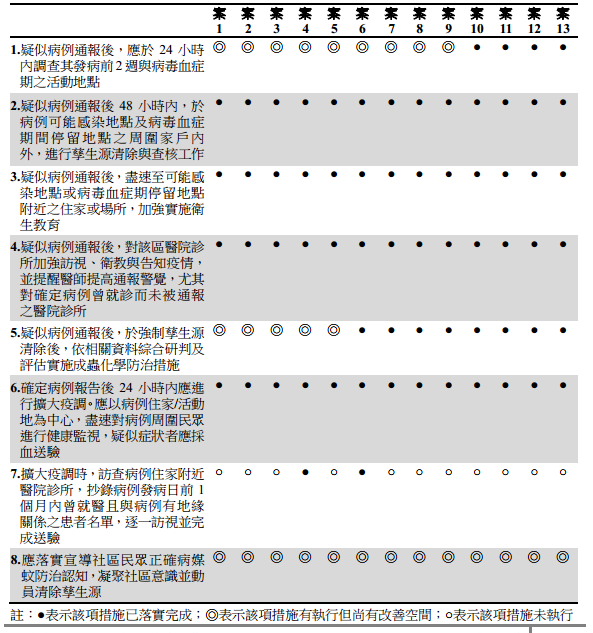
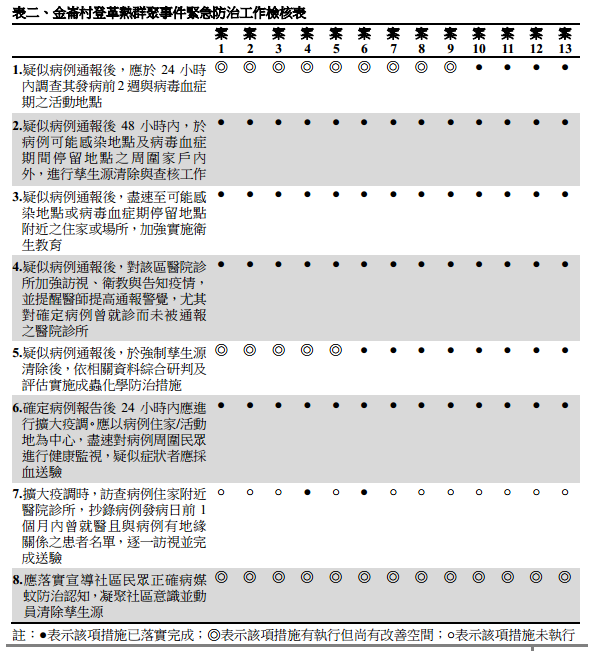
Due to climate change, the future climate will be more favorable for the survival of disease-carrying mosquitoes, which may lead to an increase in dengue fever outbreaks in the east. Therefore, the routine implementation of the prevention and control strategy in this case can be regarded as an adaptation strategy to strengthen the public health prevention and control system in response to future climate change.
Glossary
Climate change risk assessment: Using effective assessment tools to understand the medium- and long-term impacts of climate change on various sectors, and to propose corresponding adaptation strategies and actions to reduce the risks brought about by climate change.
Case type:
Structural and physical options: engineering techniques or reinforcement of existing structures, integrated technology development
Social options: learning and exchanging disaster knowledge in the community, and developing and applying early warning information.
Institutional options: Establishing institutions at the economic, policy, and legal levels
References
Liu Mingjing, Huang Wenwen, Huang Guohao, etc. The first local dengue fever cluster in eastern Taiwan. Epidemic report 2016:32(7):158-63.
Reference Websites