Taiwan - Tainan City’s 2015 dengue fever larvae eradication program
Adaptation Framework : Promote implementation
Adaptation Option : Behavioral
Issue : Dengue fever outbreak
Core Content : Encouraging breeding site elimination behaviors
Case Characteristics : practical operation
Scale : City/County
Author : Fu Zongqiang
View : 2019
Issues and Objectives
In 2015, a large-scale dengue fever outbreak occurred in Tainan. The outbreak began to escalate on May 21st, when the first local case was confirmed. By July 17th, Tainan City had accumulated 57 confirmed cases. The Tainan City Dengue Fever Epidemic Command Center was established, followed by district-level command centers and forward command posts in various neighborhoods to carry out prevention and control work. Although each case underwent 50-meter mosquito breeding site elimination and chemical control according to dengue fever prevention guidelines, and the National Army Chemical Corps was deployed on August 11th to assist with chemical control, the spread of the epidemic was not successfully prevented. On September 15th, the Executive Yuan established the Central Dengue Fever Epidemic Command Center and went to Tainan for frontline supervision. Considering the thoroughness of mosquito breeding site elimination and the correctness of chemical control methods, the Centers for Disease Control and Prevention's mosquito breeding site elimination advisory team began various mosquito breeding site elimination training and chemical control inspections on September 20th. After implementing the mosquito breeding mentor program and the enhanced mosquito breeding source elimination project, initial results have been achieved. In response to the need for a key focus of subsequent prevention and control, which is to integrate available human and material resources to mobilize the community and strengthen the elimination and promotion of mosquito breeding sites and high-risk areas in households, the Central Dengue Fever Epidemic Command Center assisted the Tainan City Government in planning the "Mosquito Eradication Plan".
Improvement Measures Taken
Extermination Plan Implementation Details and Methods:
- Plan implementation period and scope
The campaign was divided into three phases: the mobilization and elimination phase (October 31 to November 5, 2015), the verification phase (November 6 to November 7, 2015), and the review and improvement phase (November 8 to November 16, 2015). The scope of the campaign included neighborhoods with more than six cumulative cases in weeks 41-42 of 2015, as well as hotspot neighborhoods that had experienced a resurgence of fever in recent weeks (a rise in cases after an initial decline). A total of 111 neighborhoods (distributed across 7 districts) were selected.
- Implementing units and mobilized personnel
- The implementation is led by the Tainan City Health Bureau and Environmental Protection Bureau, with assistance from other relevant departments, and carried out by the district offices and neighborhood chiefs in the planning area.
- The manpower mobilized includes relevant departments of the Tainan City Government, district offices, volunteers, residents, and qualified and outstanding personnel trained by mosquito breeding instructors in various districts to carry out mosquito breeding source removal, publicity, and inspection work.
- Fifty-one outstanding individuals trained by the breeding site supervisors were appointed as team leaders and deputy team leaders, while the remaining qualified individuals served as team members. The teams were divided into 14 groups of 16 people each, including one team leader and one deputy team leader, with 14 team members remaining.
- Execution content
- Mobilization and Breeding Site Clearance Period: Warnings will be issued during this period, and inspections will be conducted one week later. All neighborhoods are requested to mobilize their residents. The district office and neighborhood chiefs will mobilize district and neighborhood breeding site clearing teams and residents to remove stagnant water containers and breeding grounds, and to inspect high-risk areas, recording and reporting the results.
- Verification period: Each team verifies the hot zone by neighborhood, calculating the mosquito index and assessing the effectiveness of community mobilization. Sub-teams conduct follow-up verifications, with each team verifying approximately 400-800 households. Verification scope principle: To maintain impartiality, each team will not verify areas outside their assigned area, using a cross-verification method.
- Review and Improvement Period: Calculate the Brucella index (vector mosquito index) for each neighborhood. The results will be statistically analyzed and scored by neighborhood and district to assess the effectiveness of each area. Those with a Brucella index of level 2 or higher will require further community mobilization and a re-examination of qualified mosquito control personnel.
- Results Compilation
The results of the verification of qualified and outstanding personnel in the mosquito control training will be filled out in the "Dengue Fever Vector Mosquito Density Survey Record Form" and suggestions will be provided. The results will be submitted to the Tainan City Government Health Bureau or Environmental Protection Bureau for compilation and evaluation.
- Reward Method
- Excellent neighborhoods for necrotic extermination: They are divided into three levels according to the number of households. Neighborhoods within the same level are compared, and the top three are selected, along with those meeting the criteria of a Brookings Indicator of 2 or less. They are awarded prizes (or equivalent gift certificates) and medals.
- Excellent larval control areas: Those selected based on the best criteria, and whose areas have no Libby index of 3 or higher, will be given administrative rewards.
- The results of the neighborhood inspection will be published on the website. Those with a Brookings Indication (BIT) level of 2 or higher will be included in the enhanced tracking and monitoring list and warning areas. The neighborhood will need to conduct further community mobilization until the qualified personnel who have eliminated breeding grounds are re-inspected. If the BIT level is 1 or lower, the improvement results will be published.
- The results of the neighborhood inspection in each district are published on the website. Neighborhoods with a Brookings Indicator (BRI) of ≤50% are listed as areas requiring enhanced tracking and monitoring. These neighborhoods need to conduct further community mobilization until the proportion of neighborhoods with a BRI of ≤50% is greater than 50% in the re-inspection of qualified personnel. Only then will the improvement results be published.
Results
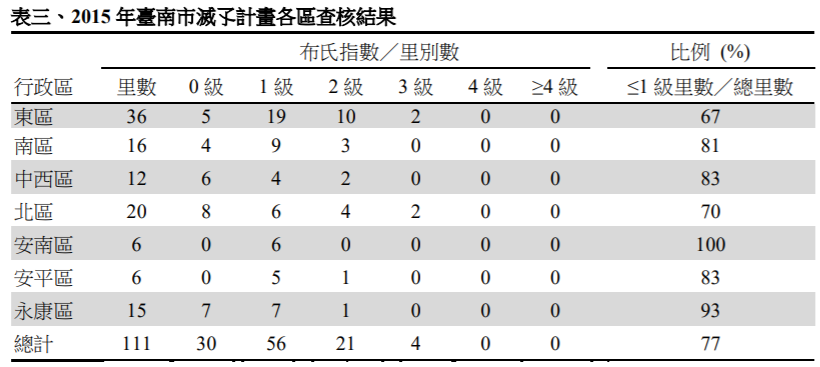
Tainan City conducted a nematode eradication program from October 31 to November 16, 2015, mobilizing and inspecting 111 neighborhoods across 7 districts. During cross-checks conducted from November 6 to 7, 86 neighborhoods had a Brinell index of 1 or lower (see Table 3 below). Looking at the districts, Annan District had the highest percentage of neighborhoods with a Brinell index of 1 or lower (100%), while East District had the lowest (67%). Across all 111 neighborhoods inspected, the percentage was 77%. East District and North District had neighborhoods with Brinell indices of 3 or higher.
Source: Reference 1
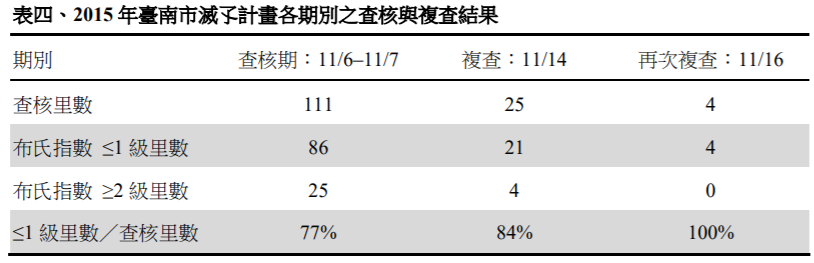
To assess the effectiveness of the brood control program, during the initial review period, 77% of the neighborhoods had a Brinell index of 1 or lower (see Table 4 below). A total of 25 neighborhoods (12 in the East District, 3 in the South District, 2 in the Central and Western District, 6 in the North District, 1 in Anping District, and 1 in Yongkang District) had Brinell indices of 2 or higher. These areas underwent a follow-up review after community mobilization. Subsequent reviews continued for neighborhoods with Brinell indices of 2 or higher. The first review on November 14th showed that 84% of the neighborhoods had a Brinell index of 1 or lower, with 4 neighborhoods (1 in the East District, 1 in the South District, and 2 in the Central and Western District) having a Brinell index of 2 or higher. A second review on November 16th showed that all 4 neighborhoods had a Brinell index of 100% or lower.
Source: Reference 1
Due to climate change, the future climate will be more favorable for the survival of disease-carrying mosquitoes, which may lead to the normalization of large-scale dengue fever outbreaks in the south. Therefore, normalizing this prevention and control strategy can be regarded as an adaptation strategy to strengthen the public health and epidemic prevention system in response to future climate change.
Glossary
Climate change risk assessment: Using effective assessment tools to understand the medium- and long-term impacts of climate change on various sectors, and to propose corresponding adaptation strategies and actions to reduce the risks brought about by climate change.
Case type:
Structural and physical options: engineering techniques or reinforcement of existing structures, integrated technology development
Social options: learning and exchanging disaster knowledge in the community, and developing and applying early warning information.
Institutional options: Establishing institutions at the economic, policy, and legal levels
References
- Tainan City Government. Dengue Fever Prevention Measures in Tainan City, 2015 (pp. 65-69).https://www.epa.gov.tw/DisplayFile.aspx?FileID=A855559D43922D95&P=f8c91f72-8ff1-4d10-8e8b-883b9597508c。
- Chi, Chin-sheng; Liu, Pi-lung; Wang, Jen-te; & Hsieh, Jui-wei (2017). Enhancing and Strengthening Dengue Fever Prevention Skills in Local Governments: A Case Study of Breeding Instructors and Larval Extermination Programs. Epidemic Reports, Vol. 33, No. 14, pp. 255-262.
Reference Websites