Taiwan - Changhua County dengue fever community cluster outbreak in 2015
Adaptation Framework : Promote implementation
Adaptation Option : Structural
Issue : Dengue fever outbreak control
Core Content : Elimination of mosquito breeding sites
Case Characteristics : practical operation
Scale : City/County
Author : Zhang Yijia
View : 1586
Issues and Objectives
On November 18, 2015, a hospital in Changhua reported a confirmed case of dengue fever in a 34-year-old male resident of Shetou Township, Changhua County. Investigation revealed no recent travel history to southern Taiwan or domestically and internationally, leading to the conclusion that the infection likely occurred in Shetou Township, Changhua County. On November 19, the Health Bureau conducted dengue fever prevention and control measures at the patient's residence, workplace, and other potential infection locations, as well as locations where the patient stayed for more than two hours during viremia. Serum samples were collected from three residents who had previously exhibited fever symptoms and sent for testing. On the evening of November 20, the Centers for Disease Control and Prevention (CDC) confirmed all three cases as dengue fever positive, designating the village as a Class A dengue fever cluster. Epidemiological investigations confirmed that all four confirmed dengue fever cases had no travel history to southern Taiwan or domestically and internationally, and that the infection occurred in Shetou Township, Changhua County. Furthermore, a community cluster infection had already formed. To clarify the source of infection and prevent the spread of the epidemic, the Changhua County Health Bureau and the CDC immediately launched an investigation into the source of infection and implemented corresponding prevention and control measures.
Improvement Measures Taken
On the afternoon of November 18, 2015, the Health Bureau received a report and conducted a preliminary investigation. The case had no recent travel history to southern Taiwan or domestic and international destinations. The onset date was November 15, with symptoms including fever, headache, and loss of appetite. Blood tests after seeking medical attention revealed low white blood cell and platelet counts, and a positive NS1 rapid test, confirming the case as a dengue fever case. Further investigation determined the infection location to be Shetou Township, Changhua County. On November 19, the Health Bureau conducted an epidemiological investigation, mosquito breeding site investigation and elimination, and chemical control within a 100-meter radius of the patient's residence. A survey of 50 households, totaling 162 residents, revealed that 3 residents had experienced fever symptoms within the past month (but none had recently traveled to southern Taiwan or domestically or internationally). Serum samples were collected and sent for testing, and no positive breeding grounds were found (Brudzinskiy index 0). On November 20, the Health Bureau reminded 25 medical institutions in Shetou Township and Tianzhong Township by telephone to strengthen reporting if there are any suspected cases of dengue fever symptoms recently.
Results
It is divided into two phases.
Phase 1 Expanded Prevention and Control Plan (November 21-23) and its Results:
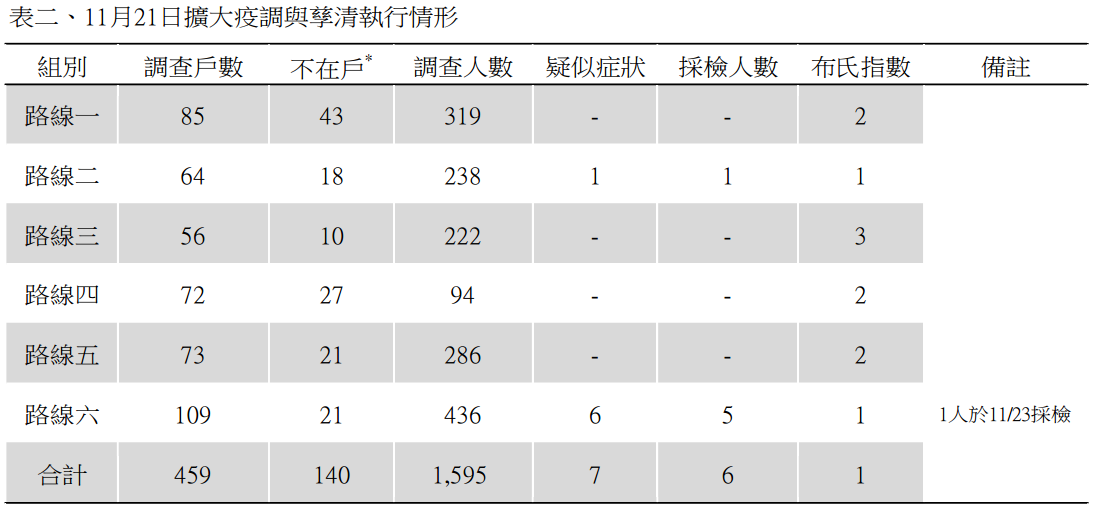
The results of the expanded epidemiological investigation and dengue breeding site eradication conducted on November 21 are shown in Table 2 below. A total of 459 households and 1,595 residents were investigated, and 7 residents had exhibited suspected dengue fever symptoms such as fever. Positive containers and containers holding water were subsequently removed. Residents are requested to report any unsanitary or littered areas and to designate specific cleaning days.
Phase Two Expanded Prevention and Control Plan (November 25-26) and its Implementation Results:
After eliminating breeding grounds and notifying residents to cooperate with chemical control efforts on November 25, the results of the mosquito breeding ground survey on that day showed a Brucell Index of 2-3. Ten mosquito larvae samples and serum samples from two residents with suspected symptoms were sent for testing.
The graph shows the popularity curve of this event:
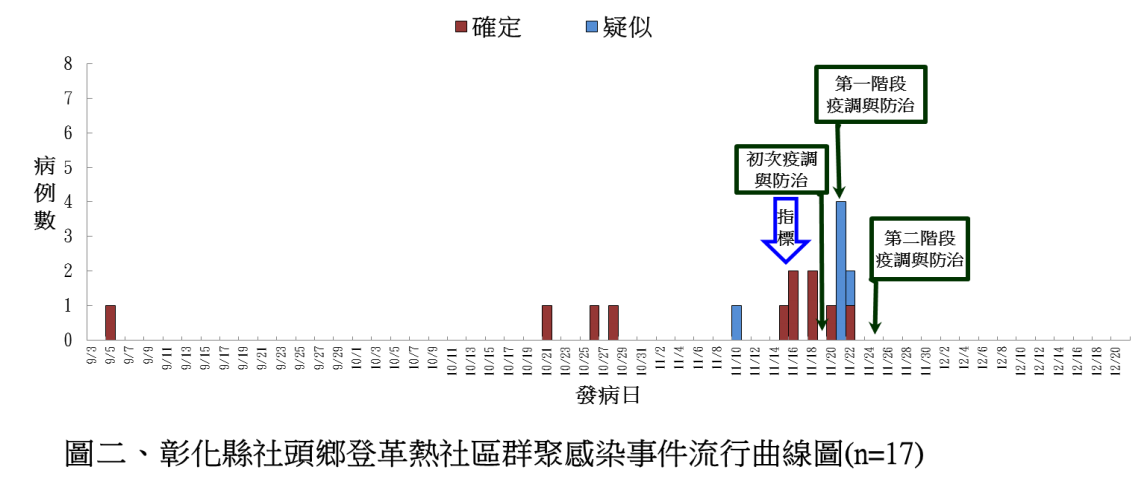
Due to climate change, the future climate in central Taiwan will be more conducive to the survival of disease-carrying mosquitoes, which may increase the risk of dengue fever in the region. Therefore, analyzing dengue fever prevention cases in central Taiwan to strengthen future regional prevention procedures can be regarded as an adaptation strategy to strengthen the public health prevention system in response to future climate change.
Glossary
Climate change risk assessment: Using effective assessment tools to understand the medium- and long-term impacts of climate change on various sectors, and to propose corresponding adaptation strategies and actions to reduce the risks brought about by climate change.
Case type:
Structural and physical options: engineering techniques or reinforcement of existing structures, integrated technology development
Social options: learning and exchanging disaster knowledge in the community, and developing and applying early warning information.
Institutional options: Establishing institutions at the economic, policy, and legal levels
References
A local dengue fever community cluster in Shetou Township, Changhua County in 2015, Zhang Suhui et al., Epidemic Report, Vol. 32, No. 13, July 5, 2016. DOI: 10.6524/EB.20160705.32(13).002
Reference Websites