Taiwan - Kaohsiung City’s first dengue fever cluster outbreak in 2017
Adaptation Framework : Promote implementation
Adaptation Option : Structural
Issue : Dengue fever outbreak control
Core Content : Elimination of mosquito breeding sites and disease prevention
Case Characteristics : practical operation
Scale : City/County
Author : Zhang Yijia
View : 1764
Issues and Objectives
On July 26, 2017, a hospital in Kaohsiung reported a suspected dengue fever case in a 31-year-old Taiwanese male residing in Dachang Village, Nanzi District, Kaohsiung City. The patient tested positive using a rapid dengue NS1 antigen test kit (NS1 rapid test). Further investigation revealed that his parents and he himself were also potential dengue carriers. After laboratory testing, the Centers for Disease Control (CDC) determined on July 17 that the mother was the first confirmed case of locally transmitted dengue fever in Taiwan in 2017. To identify the possible source of infection and implement timely prevention and control measures, an epidemiological investigation was immediately launched to prevent the spread of the disease.
Improvement Measures Taken
In terms of local government:
- Expand the epidemic investigation to confirm whether there are any suspected cases of infection in the surrounding area.
- The investigation included source elimination and chemical control, including surveys of mosquito density in Dachang and Guangchang neighborhoods, chemical control of reactive containers, vector surveillance at the Naval Academy, and vector surveillance in the neighborhoods surrounding the individual's residence and workplace.
- The medical and health centers were notified and asked to be more vigilant and strengthen their consultations. At the same time, six press releases were issued to strengthen the public's awareness of dengue fever prevention.
- The district office mobilized surrounding neighborhoods to strengthen the cleanup of breeding grounds and promote disease prevention, and local temples also hired mobile propaganda vehicles to broadcast health education along the way from time to time.
Regarding central government authorities and research institutions:
- The Centers for Disease Control and Prevention (CDC) dispatched personnel to the residence of the case to understand the local environment, conduct risk assessments, and promptly provided the findings to the local government to continue implementing related prevention and control measures such as source elimination.
- The National Research Center for Mosquito-borne Infectious Diseases Control: dispatched personnel to Dachang and Guangchang villages in Nanzi District to deploy mosquito ovitraps outdoors for one month, and also conducted the first trial of deploying gravitraps indoors. Personnel were also dispatched weekly to collect the ovitrap monitoring results.
Results
Thanks to thorough investigation and chemical control measures, the outbreak did not progress further. Health education campaigns increased overall awareness, leading to a relative increase in reported cases. Monitoring data from mosquito ovipositors and bait traps showed that after control measures were implemented in Dachang Village, both indoor and outdoor positivity rates were low, and mosquito density was well controlled. The table below shows the positivity rate of outdoor ovipositors and the number of mosquitoes captured by indoor bait traps in the neighborhoods surrounding dengue fever cases in Nanzih District, Kaohsiung City.
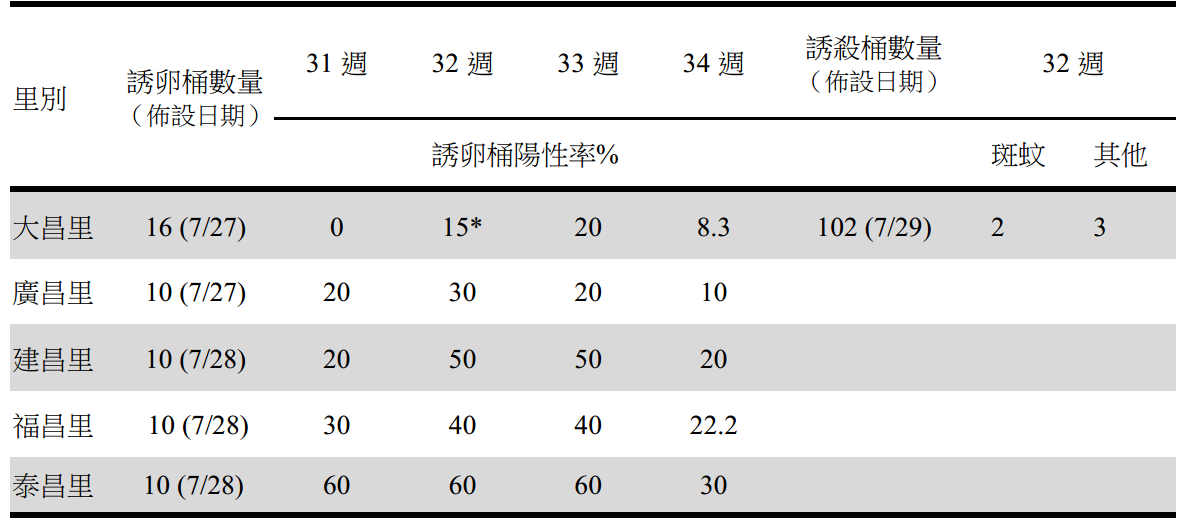
Due to climate change, the future climate will be more favorable for the survival of disease-carrying mosquitoes, which may accelerate the spread of dengue fever in the south. Therefore, the routine implementation of rapid screening and prevention strategies in this case can be regarded as an adaptation strategy to strengthen the public health and prevention system in response to future climate change.
Glossary
Climate change risk assessment: Using effective assessment tools to understand the medium- and long-term impacts of climate change on various sectors, and to propose corresponding adaptation strategies and actions to reduce the risks brought about by climate change.
Case type:
Structural and physical options: engineering techniques or reinforcement of existing structures, integrated technology development
Social options: learning and exchanging disaster knowledge in the community, and developing and applying early warning information.
Institutional options: Establishing institutions at the economic, policy, and legal levels
References
The first local dengue fever outbreak in Kaohsiung City in 2017, Lin Wen-nien et al., Epidemic Report, Vol. 34, No. 16, August 21, 2018. DOI: 10.6524/EB.201808_34(16).0001。
Reference Websites