Taiwan - New Taipei City dengue fever cluster outbreak in 2017
Adaptation Framework : Promote implementation
Adaptation Option : Structural
Issue : Dengue fever outbreak control
Core Content : Elimination of mosquito breeding sites and disease prevention
Case Characteristics : practical operation
Scale : City/County
Author : Zhang Yijia
View : 1622
Issues and Objectives
On September 26, 2017, a medical center in northern Taiwan reported a suspected local dengue fever case (index case) in a 59-year-old male residing in Yingge District, New Taipei City. Following an epidemiological investigation by health authorities, it was found that the patient developed symptoms of fever, muscle pain, and joint pain on September 24, sought medical attention at a hospital, and was subsequently transferred to the medical center in northern Taiwan for hospitalization. The hospital's rapid antigen test for NS1 (non-structural protein 1 of dengue virus) was positive, and dengue fever was reported on September 26. Further investigation revealed that the patient's wife (Case 2) developed suspected symptoms on September 20, leading to contact tracing. On September 27, both the index case and the wife were confirmed to have dengue fever. The two cases shared common activities during the incubation period in the mountainous area near their residence in Donghu Village, Yingge District, New Taipei City, and a hiking trail in Yangmei District, Taoyuan City. Because the index case had been bitten by mosquitoes while collecting bamboo shoots near his home, the initial assessment was that the infection site was the mountainous area near his residence. In order to clarify the source of infection and control the spread of the epidemic, the New Taipei City Health Bureau and the Centers for Disease Control immediately launched an epidemic investigation and other prevention and control work.
Improvement Measures Taken
The Centers for Disease Control (CDC) initiated an epidemic investigation (including investigation and testing of contacts of confirmed cases) and a possible environmental investigation of the vector mosquitoes. Following this, an investigation into the source of infection and an assessment of the epidemic situation were conducted. In addition, the New Taipei City Government convened three city-level "Emergency Inter-departmental Response Meetings for Local Dengue Fever Outbreaks" during the epidemic monitoring period, inviting relevant departments to monitor the development of the epidemic and adjust response measures in a timely manner. Furthermore, on October 12th, response centers were established in Yingge District and Tucheng District to systematically carry out prevention and control measures such as source elimination, environmental disinfection, and public health education. The following actions were taken:
- Breeding source elimination and verification work
- Mosquito surveillance
- Chemical control work
- Health education and health monitoring
Results
Environmental survey: The area was divided into three zones: A, B, and C. In Zone A, disease control personnel discovered mosquito larvae breeding in an irrigation ditch on a hillside. In Zone B, the main breeding ground was found to be bamboo joints, along with large water-collecting containers such as water tanks and abandoned water towers. In Zone C, located in the forest beside Provincial Highway 82-1, a water storage tank containing hundreds of mosquito larvae was found at the entrance. All three zones share common environmental characteristics: steep slopes inaccessible to humans and deep forests, which are unfavorable for disease control. The presence of natural breeding grounds such as leaves, tree holes, and bamboo joints, as well as large artificial water storage containers used for agricultural purposes, all contribute to mosquito breeding.
The government and relevant agencies took the following actions: The Environmental Protection Bureau mobilized 856 personnel in Yingge District, eliminating 5,283 breeding grounds and 6,417 pieces of waste. In addition, the Health Bureau (institute) and the Centers for Disease Control conducted a total of 9 inspections and issued 3 inspection and supervision records. The National Research Center for Mosquito-borne Infectious Diseases conducted monitoring and mosquito sweeping surveys at the residences and activity sites of cases in Yingge District and Tucheng District, using oviposition traps, traps, and mosquito traps. Monitoring lasted for 4 weeks, and all captured female Aedes albopictus mosquitoes tested negative for NS1 rapid screening. In addition to filling bamboo cavities and tree holes in the epidemic hotspots, the Yingge District sanitation team also conducted one residual spray with organophosphate pesticides and two space sprays with pyrethrum for adult mosquito chemical control. Adult mosquito chemical control was also applied to the residences and activity sites of the cases to reduce the risk of transmission.
The table below contains data on confirmed cases of a local dengue fever cluster in Yingge District, New Taipei City in 2017.
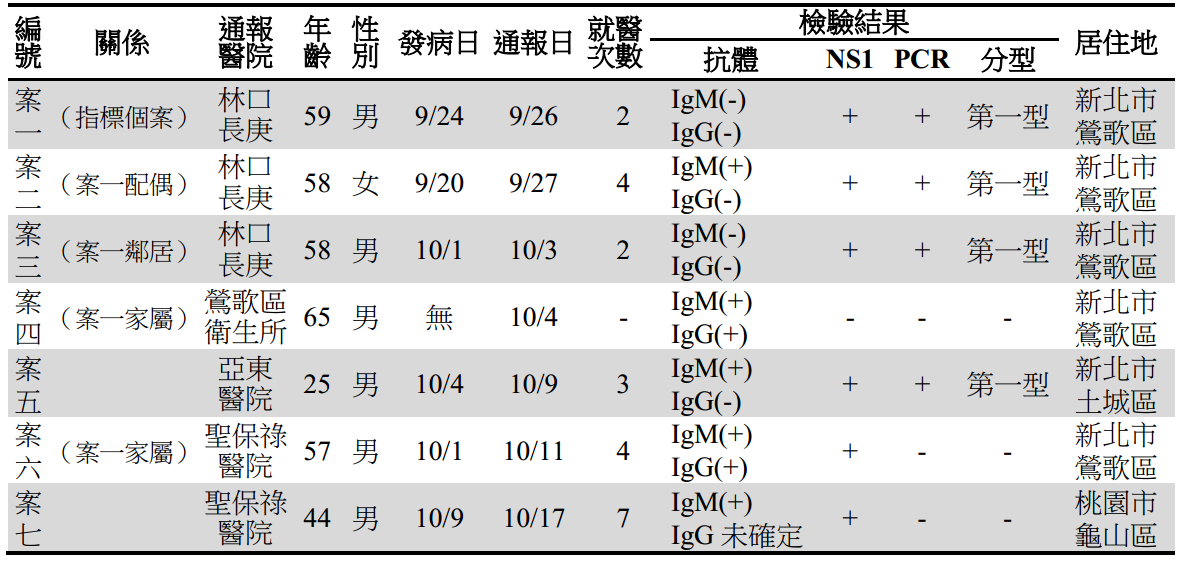
Due to climate change, the future climate will be more favorable for the survival of disease-carrying mosquitoes, which may lead to an increase in dengue fever outbreaks in the north. Therefore, the routine implementation of the prevention and control strategy in this case can be regarded as an adaptation strategy to strengthen the public health prevention and control system in response to future climate change.
Glossary
Climate change risk assessment: Using effective assessment tools to understand the medium- and long-term impacts of climate change on various sectors, and to propose corresponding adaptation strategies and actions to reduce the risks brought about by climate change.
Case type:
Structural and physical options: engineering techniques or reinforcement of existing structures, integrated technology development
Social options: learning and exchanging disaster knowledge in the community, and developing and applying early warning information.
Institutional options: Establishing institutions at the economic, policy, and legal levels
References
The 2017 local dengue fever outbreak in Yingge District, New Taipei City, Yang Yiting et al., Epidemic Report, Vol. 34, No. 11, June 5, 2018. DOI:10.6524/EB.201806_34(11).0002。
Reference Websites