Taiwan - Clustered dengue fever cases imported by Taiwanese businesses in Indonesia
Adaptation Framework : Promote implementation
Adaptation Option : Structural
Issue : Dengue fever outbreak control
Core Content : Epidemiological investigation
Case Characteristics : practical operation
Scale : City/County
Author : Zhang Yijia
View : 1872
Issues and Objectives
Dengue fever is a re-emerging viral infectious disease that has spread rapidly around the world in recent years via mosquitoes. The WHO estimates that more than 40% of the world's population, approximately 2.5 billion people, are currently at risk of contracting dengue fever. The convenience of international transportation and frequent trade have greatly increased the spread of dengue-carrying mosquitoes in different countries.
During the 2015 Lunar New Year holiday, the Taipei Area Control Center of the Centers for Disease Control, Ministry of Health and Welfare, received three suspected dengue fever cases in Yilan County, New Taipei City, and Taipei City, which were subsequently confirmed. Epidemiological investigation revealed that the Yilan County case was a Taiwanese businessman in Indonesia. Based on epidemiological data, the three cases were confirmed as an imported dengue fever cluster, with Indonesia as the country of infection. In recent years, due to climate change and frequent global trade, the number of cases this year has increased by 75.8% compared to the average of the previous three years, with Indonesia being the most common country of infection.
Improvement Measures Taken
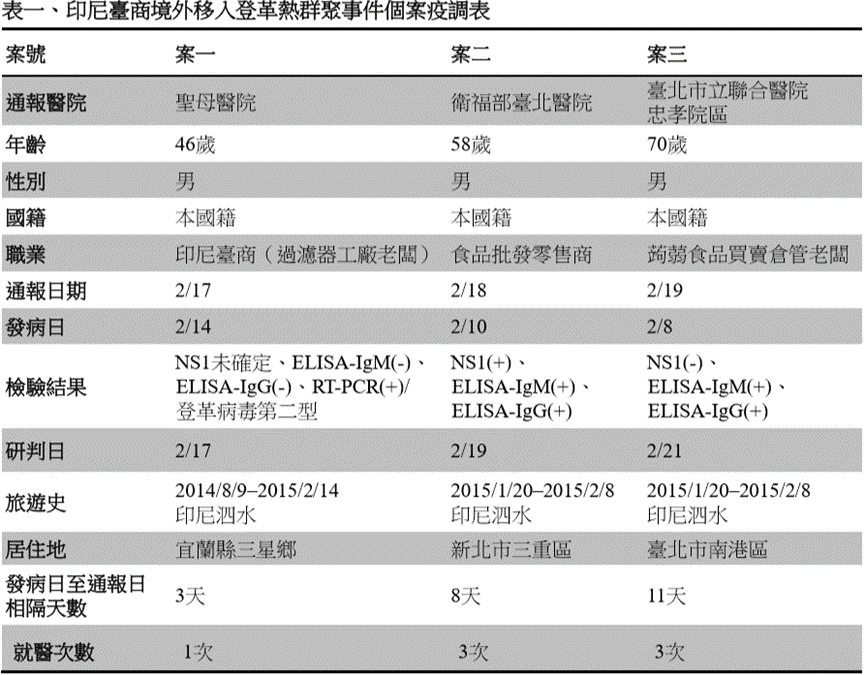
On February 17, 2015, a hospital in Yilan County reported a suspected dengue fever case (Case 1). The case involved a 46-year-old Taiwanese male businessman who had long operated a filtration equipment factory in Surabaya, Indonesia. He returned to Taiwan alone on a night flight on February 14 to celebrate the Lunar New Year. Upon arrival at the airport early the following morning, his temperature was found to be 38.3°C. Quarantine personnel from the Northern Region Control Center of the Centers for Disease Control, Ministry of Health and Welfare (CDC) immediately reported the symptoms and collected serum for dengue fever testing. Because the patient still had fever symptoms after arrival, he sought medical attention at a hospital in Yilan County on February 17. The doctor reported dengue fever, and on the same day, the CDC Research and Testing Center confirmed a positive result for dengue fever (dengue virus type 2).
On February 18, a hospital in New Taipei City reported a suspected dengue fever case (Case 2). The patient had traveled to Surabaya, Indonesia for business from January 20 to February 8. On February 10, the patient developed symptoms such as fever and fatigue. The patient visited clinics on February 10 and 14, where doctors diagnosed the patient with a cold and prescribed medication. The patient returned home to rest. On February 17, due to persistent symptoms, the patient went to a hospital in New Taipei City, where the doctor diagnosed dengue fever, took blood for testing, and admitted the patient to the hospital. On February 19, the Centers for Disease Control and Prevention (CDC) confirmed the patient as a positive dengue fever case.
On February 19, a hospital in Taipei City reported a suspected dengue fever case (Case 3). The patient had traveled to Surabaya, Indonesia from January 20 to February 8 for business. On February 8, the patient developed fever and muscle aches. On February 10, due to diarrhea (2-3 times), the patient visited a clinic and was diagnosed with a cold, prescribed cold medicine, and returned home to rest. On February 12, the symptoms had not improved, and the patient visited a clinic again, was diagnosed with a cold, prescribed cold medicine, and returned home. Because the symptoms still had not improved, and after learning that colleagues or friends contacted in Indonesia (Case 1 and 2) had been diagnosed with dengue fever, the patient went to a hospital in Taipei City on February 18. The doctor diagnosed dengue fever, and on February 21, the Centers for Disease Control and Prevention (CDC) confirmed the case as dengue fever positive.
Results
When compiling epidemiological investigation data, the Taipei District Management Center discovered that Cases 2 and 3 had similar travel itineraries, medical clinics visited, and times of medical treatment, suggesting a possible connection. Furthermore, Case 3 stated during the initial epidemiological investigation that his travel contacts also had symptoms. Therefore, the Health Bureau was asked to conduct a more detailed investigation. It was then discovered that the three cases were acquainted with each other. Case 1 was a Taiwanese businessman in Indonesia, while Cases 2 and 3 were business partners in Taiwan. Case 3 also stated that there were many mosquitoes during his business negotiations in Indonesia, and he was frequently bitten by mosquitoes while there. Through epidemiological investigation, international epidemic data, and comparison, the three cases showed an epidemiological correlation in terms of people, events, times, and locations, confirming that this was an imported dengue fever cluster from Indonesia. The Yilan County Government Health Bureau immediately carried out prevention and control measures, including source elimination, in the areas where the cases resided (Table 1).
Prevention and control measures by relevant units:
- Local health authorities: The three cases in this dengue fever imported cluster reside in Yilan County, New Taipei City, and Taipei City, respectively. The reporting period coincided with the Lunar New Year holiday. Upon receiving the report from the hospital, the epidemic prevention staff of the health bureaus of the three counties and cities immediately carried out epidemic investigation, source elimination, container reduction, and health education in accordance with the dengue fever/chikungunya prevention and control guidelines.
- Upon receiving the report from the hospital, the central competent authority, the Taipei District Control Center, immediately instructed the county and city health bureaus to conduct epidemiological investigations, source elimination, and health education in accordance with the dengue/chikungunya prevention and control guidelines. Reviewing the case investigation data revealed that cases two and three had similar entry and exit dates, medical treatment times, and locations. The health bureaus were then instructed to clarify the epidemiological investigation data for these three cases, confirming a cluster event. The health bureaus were urged to strengthen community surveillance for these three cases, implement source elimination and other prevention and control measures, and provide individual health education to prevent local dengue fever outbreaks caused by imported cases during the viremia phase being bitten by Aedes mosquitoes at home.
Due to climate change, the future climate will be more favorable for the survival of disease-carrying mosquitoes, which may lead to an increase in the international epidemic and the risk of imported infections. Therefore, strengthening border quarantine and case surveillance can be regarded as an adaptation strategy to strengthen the public health and epidemic prevention system in response to future climate change.
Glossary
Climate change risk assessment: Using effective assessment tools to understand the medium- and long-term impacts of climate change on various sectors, and to propose corresponding adaptation strategies and actions to reduce the risks brought about by climate change.
Case type:
Structural and physical options: engineering techniques or reinforcement of existing structures, integrated technology development
Social options: learning and exchanging disaster knowledge in the community, and developing and applying early warning information.
Institutional options: Establishing institutions at the economic, policy, and legal levels
References
Li Xinlun, Cai Yufang, Wu Junxian, et al. Dengue fever outbreak involving Taiwanese businessmen in Indonesia. Epidemic report 2015:31(17):440-4. DOI: 10.6524/EB.20150908.31(17).003
Reference Websites
https://www.cdc.gov.tw/File/Get/wOxy7Jz6fEUEekcPgjDydA