Taiwan - Dengue fever prevention experience of National Cheng Kung University
Adaptation Framework : Promote implementation
Adaptation Option : Structural
Issue : Dengue fever outbreak control
Core Content : Elimination of mosquito breeding sites and disease prevention
Case Characteristics : practical operation
Scale : City/County
Author : Zhang Yijia
View : 3280
Issues and Objectives
Dengue fever has always been a serious public health problem in tropical regions, particularly severe in southern Taiwan. Government policies and measures sometimes fail to cover all the details, requiring the collective efforts of the public for more effective prevention and control. At this critical time, National Cheng Kung University, located in the southernmost region and a renowned university, has stepped forward with its faculty and students to combat dengue fever, which is a significant contribution.
Improvement Measures Taken
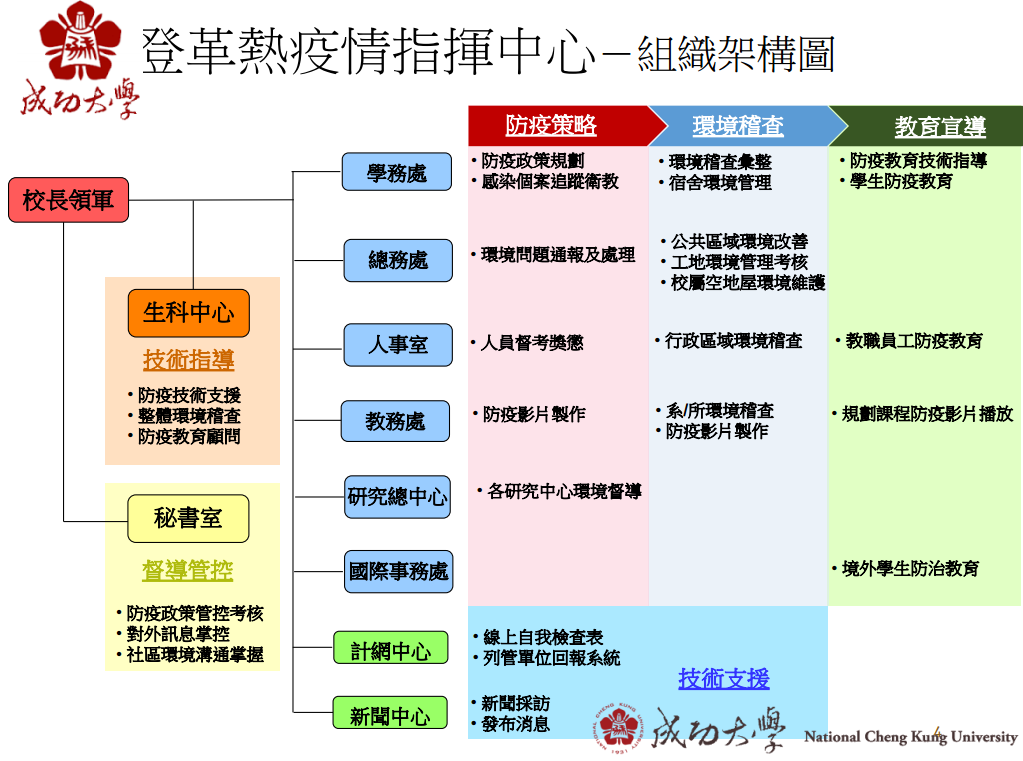
First, an epidemic command center was established, and a standard operating procedure (SOP) for epidemic prevention was set up, along with a monitoring mechanism and network. Simultaneously, various health education campaigns were conducted. Technically, the Life Sciences Center provided knowledge and techniques for biological control, including the application of Bacillus thuringiensis in shallow water or tree holes, and the rearing of mosquito-eating fish in the campus pond. In terms of policy and personnel allocation, each unit assigned a "dengue vector mosquito inspection liaison" to conduct inspections in designated areas. A "dengue inspection team" was also formed to conduct spot checks on dengue prevention measures in each unit and prepare a general survey report. When Aedes mosquitoes or mosquito larvae were found, the General Affairs Office and the Health and Wellness Office were notified for handling and investigation. A campus-wide cleaning day was established, and a dedicated dengue prevention area was set up on the school's website and updated regularly. Educational materials such as prevention cards were distributed to faculty and students.
Results
- Rational prevention: fine mesh netting, rags.
- Biohazard control: Mosquito-eating fish, Bacillus thuringiensis.
- Bleach (chlorine-based): Chlorine block.
- Salt: coarse salt, table salt.
- Environmental sanitation pesticides: organophosphates and synthetic pyrethroids.
The order of consideration should be from one to five, evaluating the costs and benefits. Please avoid using options four and five unless absolutely necessary, as they may negatively impact concrete quality or cause water pollution and ecological damage.
Principles for the prevention and control of water features in school ponds and ditches:
- Cleaning ditches: Wear long-sleeved clothing and apply mosquito repellent containing DEET.
- Kill mosquitoes immediately after opening: Spray with household insecticide immediately after opening to avoid being bitten.
- Liftable drainage ditch (net) cover: facilitates subsequent prevention and maintenance.
- Avoid spreading salt or seawater in ditches: Salt and seawater must reach a certain concentration to repel mosquitoes, but this may cause ecological damage.
- When stagnant water cannot be controlled: Keep Taiwanese fighting fish (or spotted fighting fish), rice paddy fish, guppies, or other similar fish. You can also administer Bacillus thuringiensis or other bacteria or medications that inhibit mosquito larvae.
Prevention SOP:
- Proper personal protective equipment preparation: long pants, long-sleeved shirt, hat, mask, and spray DEET mosquito repellent all over the body.
- Spray insecticides at mosquito breeding sites and empty unnecessary water containers.
- While performing the procedure, I took notes using my mobile phone.
- Record corners that are difficult to work on (such as covered ditches or tree holes).
- A few hours after applying the pesticide, once you've confirmed there are no mosquitoes left, clean the environment and try to avoid piling up items.
- Areas where returns are difficult to obtain and cannot be implemented.
- Bacillus thuringiensis was applied to tree cavities and still water areas where mosquito larvae might be present.
- After each rain, apply pesticides as needed to control mosquitoes and larvae.
Due to climate change, the future climate will be more favorable for the survival of disease-carrying mosquitoes, which may increase the scale and severity of epidemics in the south. This case provides a complete model of campus epidemic prevention strategies. If this epidemic prevention strategy is normalized, it can be regarded as an adaptation strategy to strengthen the public health epidemic prevention system in response to future climate change.
Glossary
Climate change risk assessment: Using effective assessment tools to understand the medium- and long-term impacts of climate change on various sectors, and to propose corresponding adaptation strategies and actions to reduce the risks brought about by climate change.
Case type:
Structural and physical options: engineering techniques or reinforcement of existing structures, integrated technology development
Social options: learning and exchanging disaster knowledge in the community, and developing and applying early warning information.
Institutional options: Establishing institutions at the economic, policy, and legal levels
References
As an experience sharing on dengue fever prevention at National Cheng Kung University, Mr. Yang Nien-Tsu, Dengue Fever Prevention Inspector, Health and Wellness Division, Office of Student Affairs, National Cheng Kung University.
Reference Websites
https://libapp.lib.ncku.edu.tw/libref/20160601/Session2_2.pdf