Taiwan - Insecticide efficacy testing for disease vector mosquitoes and emergency spraying SOP
Adaptation Framework : Promote implementation
Adaptation Option : Structural
Issue : Dengue fever threat
Core Content : Insecticide efficacy testing
Case Characteristics : academic research
Scale : City/County
Author : Zhang Yijia
View : 1956
Issues and Objectives
Dengue fever has always been a major public health problem in Taiwan. However, since there is currently no vaccine or specific treatment for dengue fever, prevention and control must start with controlling the mosquitoes that carry the disease. Prevention measures include door-to-door elimination of breeding grounds, releasing mosquito-eating fish, using larvicides, emergency space spraying to kill adult mosquitoes, and personal protective equipment. However, the effectiveness of pesticides against mosquitoes remains a significant challenge.
Improvement Measures Taken
- Test material collection
- mosquito culture
- Testing commercially available pesticide products
- Adult mosquito susceptibility tests: (1) adult mosquito glass tube test, (2) adult mosquito glass chamber test
- Larval susceptibility test (immersion method test)
- Collect data and develop standard operating procedures for emergency dengue spraying.
Results
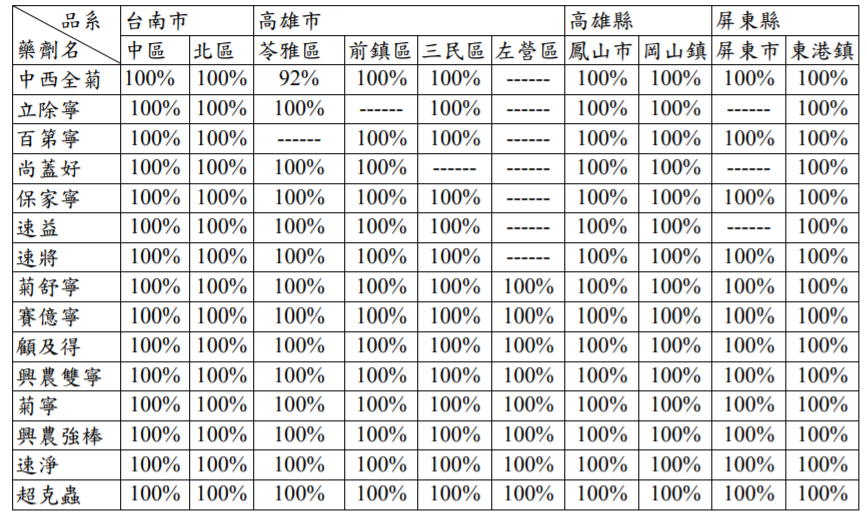
The table below shows the 24-hour mortality test results of Aedes aegypti mosquito susceptibility insecticides in dengue fever risk areas in southern China:
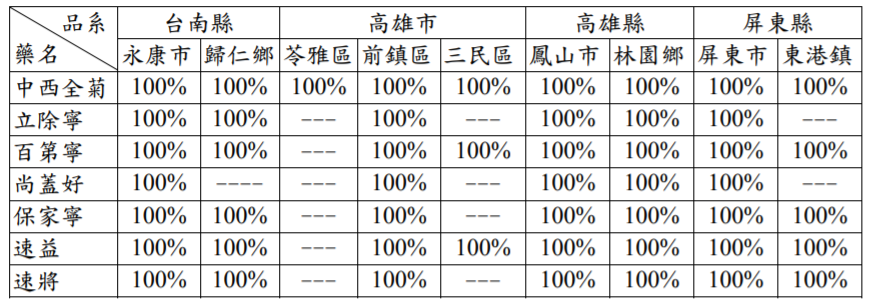
The table below shows the results of insecticide tests on Aedes albopictus mosquito susceptibility in dengue fever-prone areas of southern Taiwan:
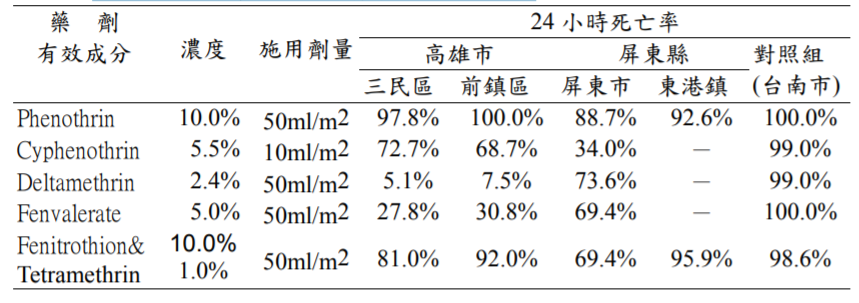
The table below shows the efficacy test results of commercially available insecticides on adult Aedes aegypti mosquitoes (female mosquitoes that have not fed for 3-7 days) using glass tanks from different laboratories:
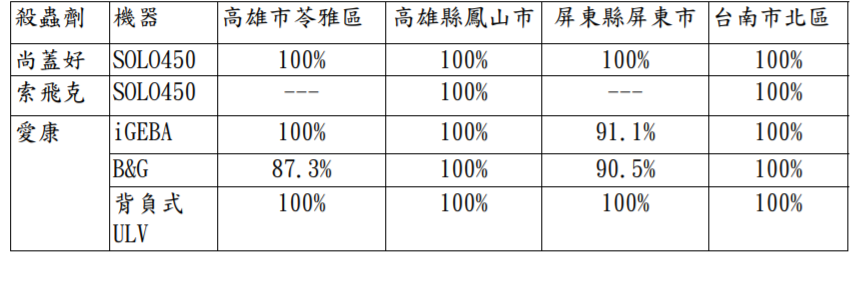
The table below shows the results of a spatial spray glass house test for Aedes aegypti mosquitoes in the southern region:
The table below shows the efficacy test results of 3rd-4th instar larvae of Aedes aegypti mosquitoes in six southern counties against commonly available insecticides:
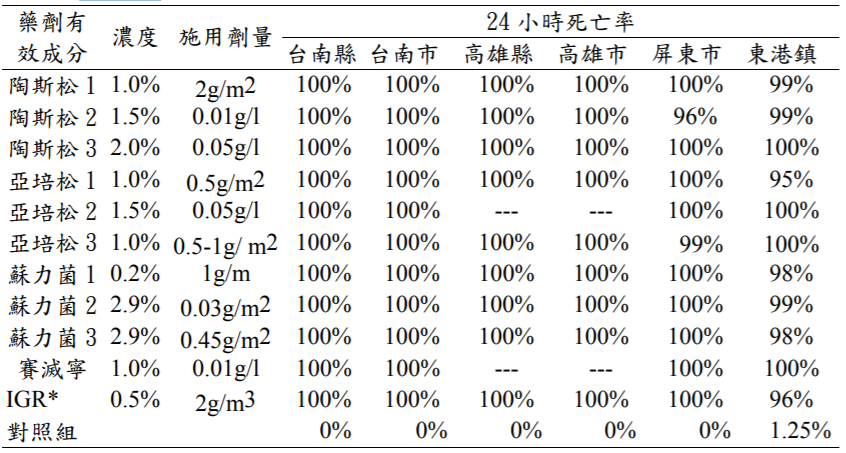
The table below shows the efficacy test results of 3rd-4th instar Aedes albopictus larvae against common commercially available insecticides:
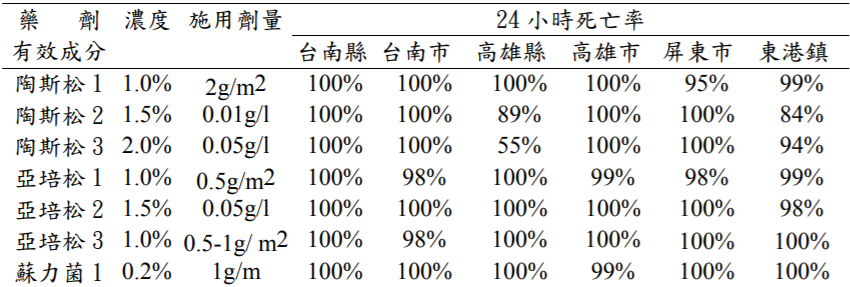
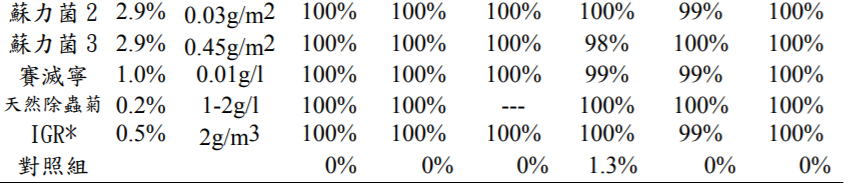
Due to climate change, the future climate will be more favorable for the survival of disease-carrying mosquitoes, which may increase the scale and severity of dengue fever outbreaks in Taiwan. This case review of the results of chemical spraying experiments on disease-carrying mosquitoes in Taiwan can serve as a reference for future chemical control. This epidemic prevention information can be regarded as an adaptation strategy to strengthen the public health epidemic prevention system in response to future climate change.
Glossary
Climate change risk assessment: Using effective assessment tools to understand the medium- and long-term impacts of climate change on various sectors, and to propose corresponding adaptation strategies and actions to reduce the risks brought about by climate change.
Case type:
Structural and physical options: engineering techniques or reinforcement of existing structures, integrated technology development
Social options: learning and exchanging disaster knowledge in the community, and developing and applying early warning information.
Institutional options: Establishing institutions at the economic, policy, and legal levels
References
Deng, Huazhen (2004). Standard Operating Procedures for Efficacy Testing and Emergency Spraying of Mosquitoes for Dengue Fever (Project No.: DOH93-DC-2036).
Reference Websites