ARK V3.0 / Customized Portal / Beginner

The integration of the basic concepts, types, and cross-platform resources of climate change adaptation can serve as an introductory reference for quickly understanding climate change adaptation knowledge.

Traditionally, disaster prevention (Disaster Risk Reduction, DRR) and adaptation (Climate Change Adaptation, CCA) share many similarities and differences. In the past, disaster prevention planning mainly relied on historical data or extrapolations thereof without warming scenarios. However, as global warming intensifies, climate science projects that the frequency and intensity of extreme climate events will increase significantly, posing more severe risks to society, the economy, and the environment. Disaster prevention should therefore consider the potential impacts under climate change, particularly disaster scales that exceed existing prevention designs or have never been experienced, and incorporate climate change projections into adaptation planning.
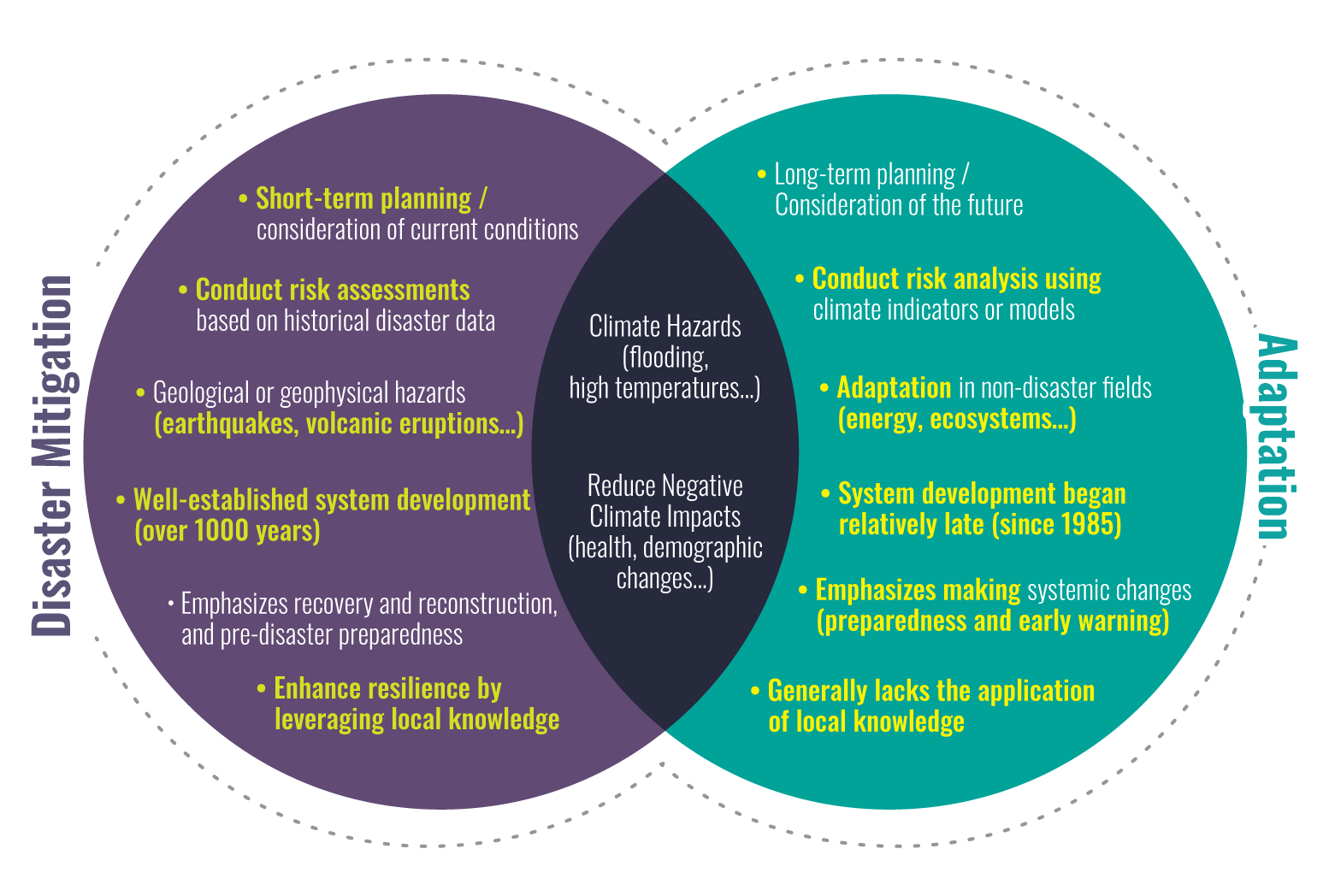
Comparison of characteristics between disaster prevention and adaptation [1]
The scopes of the two are highly related in the areas of climate hazards and climate impact domains. Disaster issues, target audiences, implementation measures, and executing entities overlap or are similar, which in turn leads to confusion and challenges in formulating disaster prevention policies or taking climate adaptation actions. For example, the differences between disaster prevention and adaptation lie in their scales and scopes of implementation, as well as in data application. Climate change adaptation emphasizes changes in climate conditions over the next 20 to 50 years. On the other hand, disaster management emphasizes pre-disaster preparedness, emergency response during disasters, and recovery and reconstruction, while adaptation focuses on changing existing systems to cope with risks that climate change may bring. Although the two differ and overlap in definition, with increasing international advocacy for their coordinated advancement, they have gradually moved toward a linked approach to enhance policy effectiveness.
In short, from the perspective of reducing disaster risk, traditional disaster prevention can be regarded as reducing the direct losses caused by natural disasters in the short- to mid-term through early warning systems, engineering improvements, and emergency response plans. Climate change adaptation, on the other hand, reduces the impacts of climate change over the long term through policies, strengthened infrastructure resilience, and socioeconomic transformation.
References
[1] 張珈瑋、陳永明、任雅婷,2023。防災調適:氣候變遷下的體系綜效與整合關鍵。國家災害防救科技中心,NCDR 111-T23