ARK V3.0 / Customized Portal / Beginner

The integration of the basic concepts, types, and cross-platform resources of climate change adaptation can serve as an introductory reference for quickly understanding climate change adaptation knowledge.

The “Climate Change Response Act” of Taiwan defines the components of climate change risk as including climate change hazards, exposure, and vulnerability [1]. Future climate change may have impacts on the public living environment, economic development, and ecological values. Therefore, public and private sectors as well as the general public need to jointly participate in thinking about and planning long-term, appropriate, and effective adaptation measures to reduce negative impacts and leverage potential beneficial opportunities.
The primary objective of adaptation is to reduce climate change risk. Therefore, the design, planning, resource investment, and level of implementation of adaptation measures must all take into account the results of climate change risk assessments as the basis for adaptation-related decision-making.
To enhance the adaptation capacity of governments at all levels in responding to extreme weather events and strengthen climate risk management, Taiwan promulgated the “Climate Change Risk Assessment Operational Guidelines” on July 16, 2025, as the basis for governments at all levels to advance adaptation policies and action plans. The Guidelines draw on the definitions in IPCC AR6 and describe climate change risk assessment as a scientific assessment that quantitatively or qualitatively evaluates climate change risks while considering the interrelated impacts of risk factors such as hazard, exposure, and vulnerability. The following explains the definitions of each risk factor under the Guidelines:
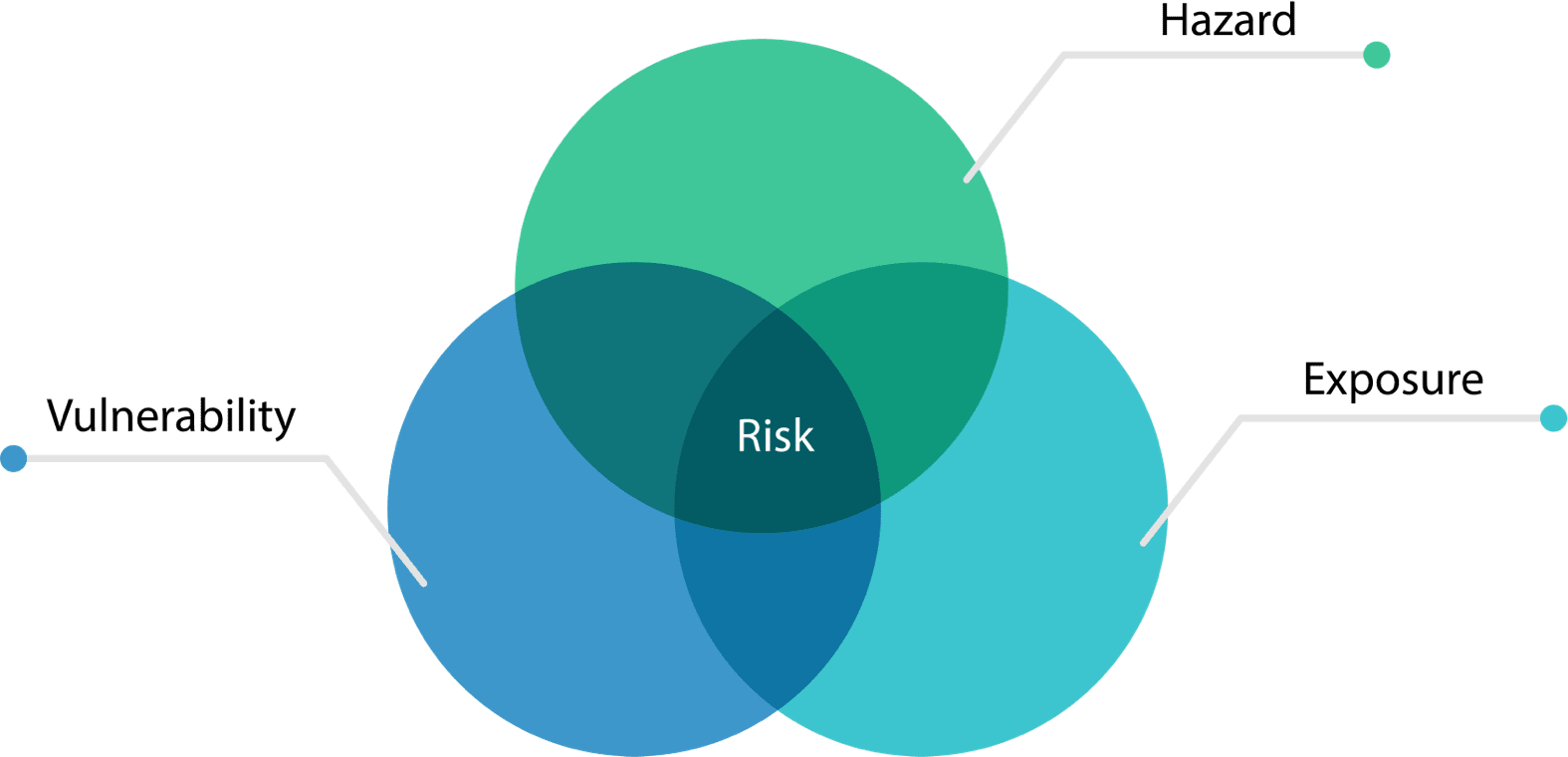
Risk components schematic (IPCC, 2014) [2]
Refers to the severity or trend of change of climate hazard events caused by natural or human factors, which may intensify adverse impacts on exposed elements. For example, changes in the probability or intensity of events such as heavy rainfall, extreme high temperatures, low temperatures, and heat waves.
The purpose of climate change risk assessment is to evaluate the gap between exposure outcomes under current conditions and future climate change risk assessment results. The methods and indicators used for current and future climate change risk assessments must remain consistent to facilitate subsequent calculations and comparisons of the extent to which future climate change risks may exceed current impact risks. This approach is used to identify future high-risk areas and adaptation gaps, serving as the decision-making basis for subsequent planning of adaptation options and for setting objectives to reduce adaptation gaps.
By way of example, the River Thames in the UK flows through major economic, commercial, and cultural hubs (exposed elements). To address climate change, including the accelerating rate of sea level rise and the increasing frequency of storm surge flooding (hazards), the UK Environment Agency reviewed the standards and conditions of multiple flood defense facilities along the Thames (vulnerability assessment). Combined with the latest climate science projections, it dynamically adjusted flood defense standards and land use strategies, and formulated the “Thames Estuary 2100 Plan.”
References
[1] ClimateChange Response Act
[2] IPCC. (2014). Summary for policymakers. In: Climate Change 2014: Impacts, Adaptation, and Vulnerability. Part A: Global and Sectoral Aspects. Contribution of Working Group II to the Fifth Assessment Report of the Intergovernmental Panel on Climate Change [Field, C.B., V.R. Barros, D.J. Dokken, K.J. Mach, M.D. Mastrandrea, T.E. Bilir, M. Chatterjee, K.L. Ebi, Y.O. Estrada, R.C. Genova, B. Girma, E.S. Kissel, A.N. Levy, S. MacCracken, P.R. Mastrandrea, and L.L. White (eds.)]. Cambridge University Press, (pp. 1-32).