ARK V3.0 / Customized Portal / Beginner

The integration of the basic concepts, types, and cross-platform resources of climate change adaptation can serve as an introductory reference for quickly understanding climate change adaptation knowledge.

As climate change risks intensify, existing adaptation measures may no longer be sufficient to address increasingly severe impacts and risks. Therefore, climate adaptation needs to break through existing approaches and undergo transformation [3][4]. Therefore, it is necessary to understand what incremental adaptation and transformational adaptation are in order to help assess whether or not current adaptation planning requires adjustment and innovative breakthroughs.
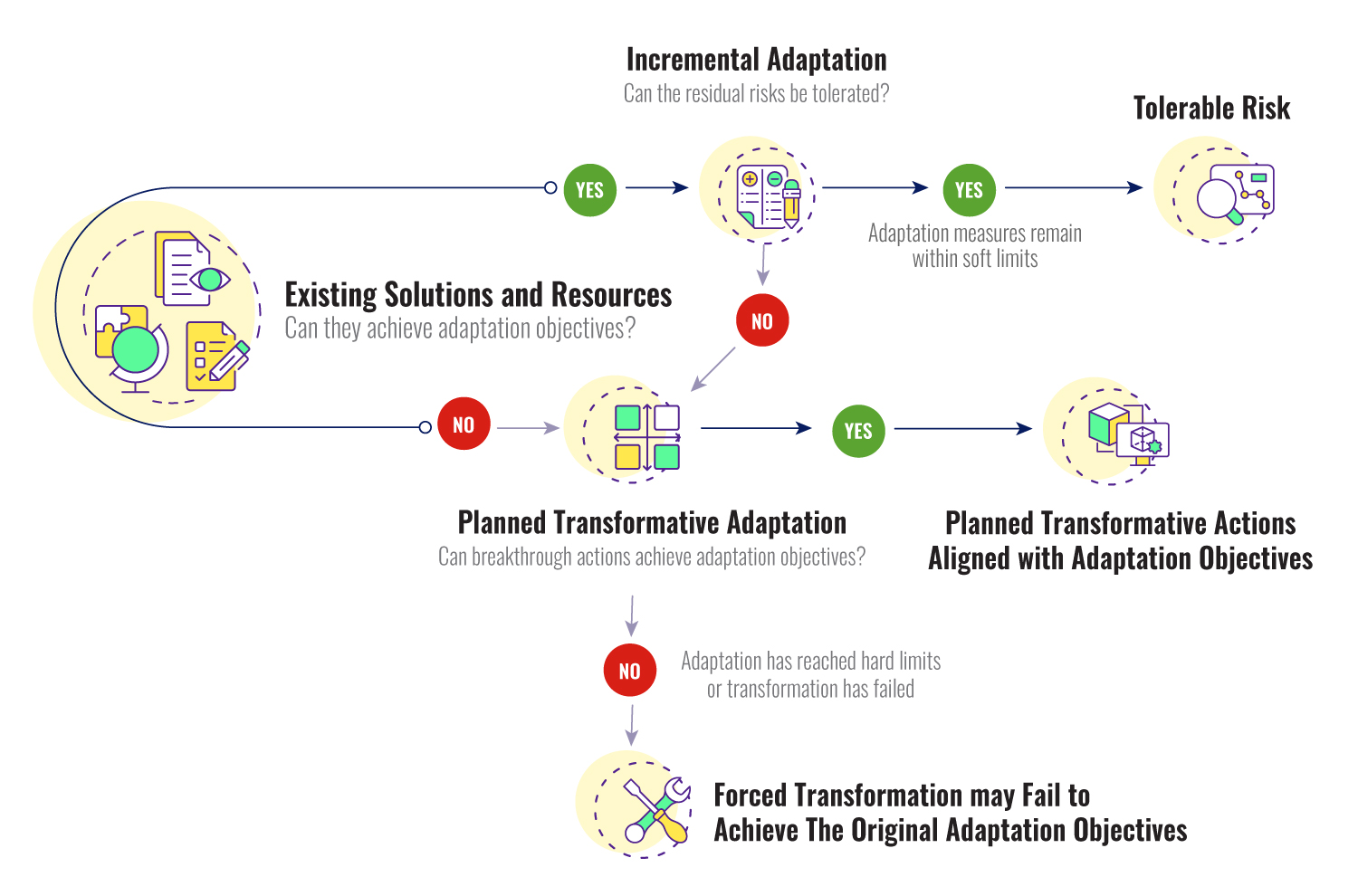
Adapted from IPCC WG2 Ch.1, Figure 1.9 [3]
Further reading
IPCC氣候變遷第六次評估報告「衝擊、調適與脆弱度」之「漸進式與轉型式調適」論述摘要
References
[1] IPCC. (2022). Climate Change 2022: Impacts, Adaptation and Vulnerability. Contribution of Working Group II to the Sixth Assessment Report of the Intergovernmental Panel on Climate Change [H.-O. Pörtner, D.C. Roberts, M. Tignor, E.S. Poloczanska, K. Mintenbeck, A. Alegría, M. Craig, S. Langsdorf, S. Löschke, V. Möller, A. Okem, B. Rama (eds.)]. Cambridge University Press.
[2] Kates, R.W., Travis, W.R., & Wilbanks, T. (2012). Transformational adaptation when incremental adaptations to climate change are insufficient. PNAS, 109(9), 7156-7161.
[3] Iizumi, T. (2019). Emerging Adaptation to Climate Change in Agriculture. In: Adaptation to Climate Change in Agriculture, Springer, pp 3–16, DOI: 10.1007/978-981-13-9235-1_1
[4] IPCC. (2014). Summary for policymakers. In: Climate Change 2014: Impacts, Adaptation, and Vulnerability. Part A: Global and Sectoral Aspects. Contribution of Working Group II to the Fifth Assessment Report of the Intergovernmental Panel on Climate Change [Field, C.B., V.R. Barros, D.J. Dokken, K.J. Mach, M.D. Mastrandrea, T.E. Bilir, M. Chatterjee, K.L. Ebi, Y.O. Estrada, R.C. Genova, B. Girma, E.S. Kissel, A.N. Levy, S. MacCracken, P.R. Mastrandrea, and L.L. White (eds.)]. Cambridge University Press, (pp. 1-32).